
If you have watched the Netflix series, or read the trilogy by Chichin Liu, you’ll know that the Three Body Problem is an impossible challenge. The San-Ti, or Trisolarans, live on a planet caught in a trinary system – three suns!
Calculating Earth’s orbital path around the sun is pretty easy compared to the math required in a binary system, where two suns orbit each other. It is virtually impossible to work the calculations of a planet’s orbit in a trinary, three-sun system like the Alpha Centauri system, closest to our own solar system.
And yet NASA recently announced a surprising revelation – the Kuiper Belt appears to contain at least one, probably two, and possibly scores of stable three-body systems.
The Kuiper Belt is a donut-shaped region of icy, rocky debris believed to be left over from when our sun formed, 4.5 billion years ago. Slowly orbiting the sun just beyond Neptune, at a fantastic distance of 3.7 billion miles (44 times the distance between the earth and the sun) the belt features icy bodies like comets, dust, and objects as small as a bus and as large as a planet – Pluto is a Kuiper Belt object.
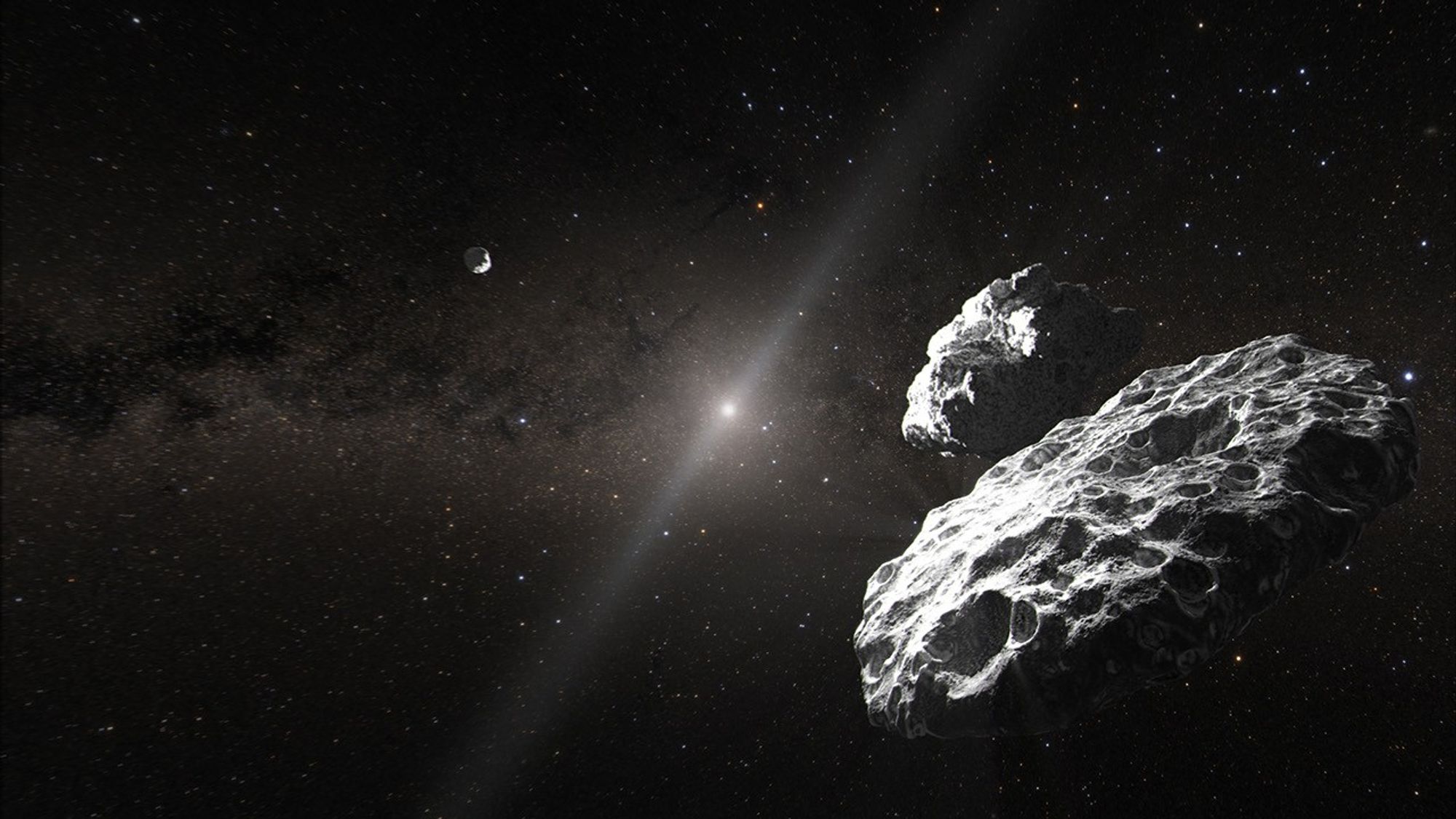
148780 Altjira was at first thought to be a pair of space rocks orbiting one another in the belt when they were spotted by the Hubble Space Telescope back in 2011. Since then, frequent observations from the Hubble and the Keck Observatory in Hawaii have determined the presence of a third object in the tiny Altjira system.
To be clear, these are not suns, but rocky remnants of the process that formed our own sun.
The system is composed of one large body locked in orbit with another body just 4,700 miles away. That second body had been assumed, since its discovery back in 2011, to be a single, rocky mass.
But recent observations have revealed it to most likely be a pair of bodies, perhaps so close together as to be touching one another. The discovery makes Altjira a stable trinary system.
Further observations are required to confirm the theory, but a trinary system seems the most likely explanation for Altjira’s orbit.
If Altjira is proven to be a trinary, it could not have been formed through collisions with other Kuiper Belt objects, but have formed through the accumulation of dust and gases like the other solar system planets.
This makes the little Altjira system, like Pluto and MakeMake, yet another proto-planet.
Does Altjira solve the Three-Body Problem? No, no it doesn’t. But it does provide some interesting clues about the formation of our solar system, and proves, once more, that the Kuiper Belt is packed with surprises and teeming with information about the formation of our solar system.
For more information on Altjira, visit the NASA article here.
John D Reinhart is a technical writer specializing in planetary science. He’s been widely published across the Web. He can be found at JohnDReinhart.com.
 John D Reinhart