
Marketing Ploy: Chapter Added

cropped-cropped-009.jpg

Okay, no lies here. Only the straight up truth. Something inside says to publish the chapters of this book, one miserable week at at time, until the book is laid completely before you. So, submitted for your approval, MARIGOLD’S END, Chapter 3. You’ll find it over there, on the left, under the title MARIGOLD’S END, the Novel. See how it works?

So, why publish chapters of the book. Once you’ve read it, you’re not likely to buy, like, a dozen copies. Maybe you could – they make great Christmas presents and passable doorstops – but no one is holding their breath.

No, it’s something more fundamental than marketing. What is the WWW if not the marketplace of the world. What is the Internet, and the ability to publish whatever, whenever, if not a way to float ideas, to share thoughts, to trade our works of art with one another?

In Shakespeare’s time, he published his own work through a publisher, hoping that it would sell. But more than just hoping for a little quick cash, a little Elizabethan jingle-in-the-jeans, he had to write, had to publish, had to share his words.

You’re a writer, you understand. You do the blog thing as a way to express yourself.

More, this is marketing. While I want you to read this book, and  DROPPINGTON PLACE, my next book, I really want to impress in your mind that my books are good and entertaining and worth the paltry shekels one shells out for them. I’m not marketing these books, but their children.

Which, according to gorilla marketing, means I’m not marketing at all, but publicizing.  You, John or Jane Q. Public – isn’t it weird that John and Jane have the same middle initial? It must be Quincy – are not being marketed, but are reading a fine piece of publicity. No pictures, please.

So, go on over and click on MARIGOLD’S END, the Novel, and breeze through Chapter 3. I hope you enjoy reading it as much as I enjoyed writing it.

Oh, and enjoy the publicity. No pictures, please.
BN Marketing Promise Kept

Apocolypse

I’d say this promise is kept by popular demand, but you, dear reader, and I both know that that’s not true, for there is only you and me in this cruel-hearted world. Please place your beer here – _____ – for crying into, later. For we have work to do now.

First and foremost: below you will find the outline for my book, DROPPINGTON PLACE, precisely as promised in yesterday’s post on Bare Naked Marketing. An important part of marketing, of course, is delivering on your promises. Some of those promises are implied. If you shell out several dollars for a Yugo, that the car has a steering wheel is implied, along with seats and a suitably tame headliner.   But a promise like “I will share this with you,” well, that’s a promise with no ifs, ands or butterumpusses about it.

If you were a playwright, you’d know this formula:

Act I: we meet the protagonist and his circumstances. All is well until, just at the end, something dreadful shatters his peaceful existence.

Act II: things gets worse and worse, more and more dire, nastier and nastier, until, at the very end of the act, the idea emerges that will save all.

Act III: we act on the idea, vanquish the dreadfulness, and resolve the manifold puzzles presented during the day. If it’s a musical, the audience walks out humming the overture.

In DROPPINGTON PLACE, we don’t have quite that much structure. You’ll find the outline over there, on the left of this site, under the strikingly original title DROPPINGTON PLACE: Outline.

So, there it is, you and I are sealed at the word processor. I share this with you in the hopes of giving you a window into my creative process.

I trust, of course, that we won’t see you running down the street with my outline in hand bellowing “Eureka! I know what to write!” That would bring bad juju, wouldn’t it?

Your ideas are always welcome – simply comment on this blog.

Stay tuned, dear reader. There are chapters, both of this book and MARIGOLD’S END, to follow.


Remember: no running.

Bare Naked Marketing

man-wearing-barrel-580115

Please disregard the provocative headline… nobody here is taking off their clothes. Probably.

So, whatever does one mean by bare naked marketing? Unlike guerilla marketing, which takes advantage of life’s nooks and crannies to broadcast one’s message, and unlike gorilla marketing, which is naked by default… seriously, how many gorillas look good in yoga pants… bare naked marketing is a new concept, proposed by yours truly.

BNM… the rule for technical writers goes like this: bare naked marketing (BNM), but that’s tedious… is organic marketing. As nobody reads this blog, I’ve decided to expose myself – all right, just my artistic soul – on my current project, DROPPINGTON PLACE.

We’ve already discussed designing the story, and I may have posted a chapter.  We have therefore already explored part of my new marketing ploy… I mean, plan.

BNM: starting tomorrow, you will get to see the writing process that goes into this book. The outline will be posted here, along with changes as they occur. Chapters, as they are finished, will be here, too.

Why BNM? You’re a writer, right? Well, so am I.  Does it not make sense to share our thoughts and processes? I mean, it’s not like some great big secret? Should it be? I think not!

So, starting tomorrow, visit here for the much ballyhooed Bare Naked MARKETING. Clothing on your part is entirely optional.

Designing a Book 


CarlsHouse

At first you think, whoa, I am, like, so going to write this book that it’s just going to be the best darned thing anybody has every gosh darned read. Then you sit down at the word processor…

It was a dark and stormy night…backspace, backspace, backspace

You may wonder why I’m dead… backspace, backspace, backspace

You’re not the boss of me, Timmy snarled… backspace, backspace, double backspace, control-X

All right, so, that knock at the front door is clearly not your muse, come to enlighten you…

My book, DROPPINGTON PLACE, has gone through iteration after iteration, the story orbiting around plot point after plot point, through about 17 “hot-dang, this’ll be good” rewrites, and finally sat down and breathed out.

That’s when Byron, the protagonist, stepped in. It turns out he really did have a story to tell – something serious he wanted to say. His story is actually pretty good – a little calm compared to previous editions of his book, but pretty good.

In the original story, Byron finds himself transported to a world of paper, run by a magical being called a homunculus. However will he get back? Assisted by two human friends and a couple of paper people, he eventually gets the homunculus to send him home. Yawnzers, kids. It’s a cool idea, but, like the paper world he visits, seriously flat.

Byron recently announced that he was not happy in the 3D world. His father has left. His mother has “episodes” that pull her emotionally far away, and he misses his best friend, left behind when they moved to a new town. He finds his escape from his woes by building paper houses.

The paper world into which he is thrust holds much more mystery for him, and might even be a place in which he can find respite. We spend most of the story wondering, with him, if the place is real or a dream. The homunculus is a paper copy of a 15th century playwright, and stands in as sort of a father figure for Byron.

We still have all the interesting paper stuff going on, and there’s a bad guy, but that’s no longer what drives the story.

The motor behind the story is Byron’s emotional arc, as he learns to cope with the many difficult issues he must face.

Fine, fine, well and good. Jeepers, mister, you’re a GENIUS, but having a character arc don’t do crackers for the structure of the book.

To remedy that ill, I broke the cracking-good synopsis for DROPPINGTON PLACE into chapters, to wit:

 “…

Chapter 2

At first the fascinating paper world is appealing, as it provides an escape from the woes of the real world. But, after seeing a 3D human like himself turned into a 2D paper person, he realizes he is in danger.


Chapter 3


Searching for a way out, he meets Hailey, a strikingly bright and hopeful 12 year old, who hopes to assist the tiny man requesting help. She uses her knowledge of magic, gained through reading a series of young-adult novels, to explain and understand the paper world. Together they witness Hobbs turn a 3D human into a 2D “flatso” as Byron calls them. They realize that Hobbs is the way out, and decide to visit his castle, Hobbs Manor…”


Now Byron can say all the stuff that’s important, but the rhythm of the book is a flow that can be managed and developed. Each character can say their important stuff, but this outline tells them when to say it.


There is a danger, my writer friend, of getting too detailed in the outline – I know some writers who fall into this sinister little trap. They write and write, not on the book, but in the outline, and solve all of their puzzles so thoroughly that they now see no need to write the book!


So, sketchy and loose, detailed but easy-peasy, that’s the road for Byron!

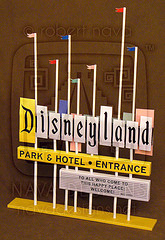
Writing at Disneyland

Image: Disneyexperience.com

There’s something sort of crazy about being, well, sort of crazy. At the top of the list is that you don’t have to explain anything – well, I’m just sort of crazy like that.   You get lots of clever adjectives, like quirky, and different. And, because you’re just sort of crazy like that, you know, quirky and different, you find yourself with lots of free time on your hands. Let’s not invite her – you, know, she’s quirky and different.

This big and mighty world tries really hard to convince you that being busy is doing something. You can be busy all day long at Disneyland, but, what have you accomplished beyond exhausting yourself and dropping two hundred bucks to a guy in a mouse costume? Nothing, Jack. For all that busyness, you accomplished nothing.

So it is with we quirky, different writers, dontcha think? This endeavor right here, this very one you are reading, which hopefully brings a smile to your erstwhile lips and perhaps gives you something over which to mull when you are not busy being busy, may very well be busyness for the sake of busyness.

It occurred to me while thinking about marketing…I mean, promoting…my book, my mind spinning feverishly like a rabid squirrel in a hamster wheel, that there is nothing to do about marketing…I mean, promoting…my book until my adorable editor is done with it. For the record, she did say she thought this was the best so far, but had scarcely started chapter two. Sigh.

Without a product, what is there to promote?…coming soon from John Reinhart, the author who is, well, uh, is kinda waiting in limbo while his editor wraps up his glorious…wait, where ya going?

BUT, there is a sequel to MARIGOLD’S END, tentatively titled PELICAN’S WAY… there’s sort of a theme here, see, where the Marigold is a ship in the first novel that gets blown up…oh, poop, I spoiled the ending…double poop, because NOW I spoiled the ending by telling you that Phineas blows it up at the end of the book…oh, triple poop! So, see, Pelican is a ship in the next book that gets…well, you’ll have to read that one.

Anyway, the rabid squirrel brains rattled out a good synopsis of that book on Tuesday. And I must say, it’s a ripping good synopsis, as synopses go. That was Tuesday.

On Wednesday, the quirky, different sort of crazy writer that I am, I sort of cracked out a terrific synopsis for my other series of books, called DROPPINGTON PLACE. For a preview of Droppington, scroll to the bottom of this page and you’ll see that I have a blog for that, too. Oh,  I’ve thought of everything.

So, while my lovely editor does everything other than edit my book, my NEW plan is to work on DROPPINGTON PLACE. And thus my hands will be busy.

But, is busyness productivity? If the words crackle and dance from your fingertips, but never get published, is that accomplishing anything?

Maybe that’s why my crazy, quirky, different friends are so fond of Disneyland.

Droppington Place – A New Neighborhood

Droppington

I’ve often wondered, but have been too lazy to explore, the link between the words journey and journalist. Both have the same root word, which means “day” in French.

Root words notwithstanding, this site has taken a most interesting road to get here: Droppington Place.

It began as a blog about a garden railway. My wife and I bought a house that had a working G-scale railway in the backyard. It was pretty cool, but rough, and not very well designed, which made running it with our young kids a bit of a challenge. The kids grew older and lost interest, and dogs and cats and nature all took their toll.

The blog chronicled the restoration of the railway from its semi-buried condition to an operational railroad. Along the way I realized I don’t like G-scale: at 1/18th scale, more or less, it’s too big for my taste. I say more or less, because the actual scale of G-scale is rather ambiguous, ranging from 1/18th to 1/32nd. Give me HO, at a constant 1/87th scale.

The URL for the blog, called  PoolsideRails.com, was devoted to chronicling the conversion of a G-scale garden railway to HO scale. Experts shook their heads and clucked: you can’t do HO outside. Well, it turns our they are correct. I found out that I don’t have the engineering finesse to pull off an outdoor HO railroad because, really, I don’t like model railroading. I like the miniatures.

So, away went  PoolsideRails and in came a new URL called Papertecture – an exploration of HO scale paper buildings with a whole section devoted to HO scale vehicles: I like little cars.

While all this was going on, I began working on a novel called Droppington Place, about a disenfranchised twelve year old who finds himself in a paper world run by a homunculus, a paper alchemical copy of a human being. It’s a pretty cool book.

Papertecture didn’t go anywhere. PoolsideRails didn’t go anywhere. The blog didn’t go anywhere. Because they were meant to come together here: Droppington Place.

Your reward: according to the Online Etymology Dictionary, journey comes from the twelfth century French word for “a day’s travel.” Journalism has at it’s root the word journal, which is a French word for a day, jornal in the 14th century. Some time in the 15th century it became synonymous with the word “diary.” Go figure.