Designing a Book 


CarlsHouse

At first you think, whoa, I am, like, so going to write this book that it’s just going to be the best darned thing anybody has every gosh darned read. Then you sit down at the word processor…

It was a dark and stormy night…backspace, backspace, backspace

You may wonder why I’m dead… backspace, backspace, backspace

You’re not the boss of me, Timmy snarled… backspace, backspace, double backspace, control-X

All right, so, that knock at the front door is clearly not your muse, come to enlighten you…

My book, DROPPINGTON PLACE, has gone through iteration after iteration, the story orbiting around plot point after plot point, through about 17 “hot-dang, this’ll be good” rewrites, and finally sat down and breathed out.

That’s when Byron, the protagonist, stepped in. It turns out he really did have a story to tell – something serious he wanted to say. His story is actually pretty good – a little calm compared to previous editions of his book, but pretty good.

In the original story, Byron finds himself transported to a world of paper, run by a magical being called a homunculus. However will he get back? Assisted by two human friends and a couple of paper people, he eventually gets the homunculus to send him home. Yawnzers, kids. It’s a cool idea, but, like the paper world he visits, seriously flat.

Byron recently announced that he was not happy in the 3D world. His father has left. His mother has “episodes” that pull her emotionally far away, and he misses his best friend, left behind when they moved to a new town. He finds his escape from his woes by building paper houses.

The paper world into which he is thrust holds much more mystery for him, and might even be a place in which he can find respite. We spend most of the story wondering, with him, if the place is real or a dream. The homunculus is a paper copy of a 15th century playwright, and stands in as sort of a father figure for Byron.

We still have all the interesting paper stuff going on, and there’s a bad guy, but that’s no longer what drives the story.

The motor behind the story is Byron’s emotional arc, as he learns to cope with the many difficult issues he must face.

Fine, fine, well and good. Jeepers, mister, you’re a GENIUS, but having a character arc don’t do crackers for the structure of the book.

To remedy that ill, I broke the cracking-good synopsis for DROPPINGTON PLACE into chapters, to wit:

 “…

Chapter 2

At first the fascinating paper world is appealing, as it provides an escape from the woes of the real world. But, after seeing a 3D human like himself turned into a 2D paper person, he realizes he is in danger.


Chapter 3


Searching for a way out, he meets Hailey, a strikingly bright and hopeful 12 year old, who hopes to assist the tiny man requesting help. She uses her knowledge of magic, gained through reading a series of young-adult novels, to explain and understand the paper world. Together they witness Hobbs turn a 3D human into a 2D “flatso” as Byron calls them. They realize that Hobbs is the way out, and decide to visit his castle, Hobbs Manor…”


Now Byron can say all the stuff that’s important, but the rhythm of the book is a flow that can be managed and developed. Each character can say their important stuff, but this outline tells them when to say it.


There is a danger, my writer friend, of getting too detailed in the outline – I know some writers who fall into this sinister little trap. They write and write, not on the book, but in the outline, and solve all of their puzzles so thoroughly that they now see no need to write the book!


So, sketchy and loose, detailed but easy-peasy, that’s the road for Byron!
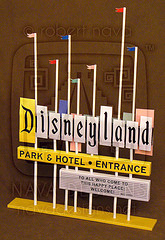
Writing at Disneyland

Image: Disneyexperience.com

There’s something sort of crazy about being, well, sort of crazy. At the top of the list is that you don’t have to explain anything – well, I’m just sort of crazy like that.   You get lots of clever adjectives, like quirky, and different. And, because you’re just sort of crazy like that, you know, quirky and different, you find yourself with lots of free time on your hands. Let’s not invite her – you, know, she’s quirky and different.

This big and mighty world tries really hard to convince you that being busy is doing something. You can be busy all day long at Disneyland, but, what have you accomplished beyond exhausting yourself and dropping two hundred bucks to a guy in a mouse costume? Nothing, Jack. For all that busyness, you accomplished nothing.

So it is with we quirky, different writers, dontcha think? This endeavor right here, this very one you are reading, which hopefully brings a smile to your erstwhile lips and perhaps gives you something over which to mull when you are not busy being busy, may very well be busyness for the sake of busyness.

It occurred to me while thinking about marketing…I mean, promoting…my book, my mind spinning feverishly like a rabid squirrel in a hamster wheel, that there is nothing to do about marketing…I mean, promoting…my book until my adorable editor is done with it. For the record, she did say she thought this was the best so far, but had scarcely started chapter two. Sigh.

Without a product, what is there to promote?…coming soon from John Reinhart, the author who is, well, uh, is kinda waiting in limbo while his editor wraps up his glorious…wait, where ya going?

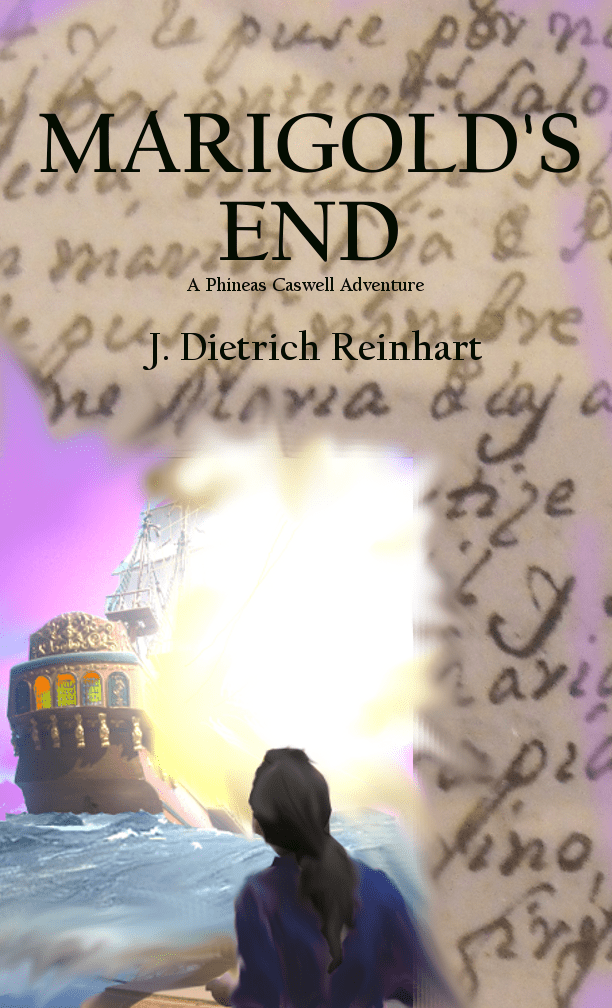
BUT, there is a sequel to MARIGOLD’S END, tentatively titled PELICAN’S WAY… there’s sort of a theme here, see, where the Marigold is a ship in the first novel that gets blown up…oh, poop, I spoiled the ending…double poop, because NOW I spoiled the ending by telling you that Phineas blows it up at the end of the book…oh, triple poop! So, see, Pelican is a ship in the next book that gets…well, you’ll have to read that one.

Anyway, the rabid squirrel brains rattled out a good synopsis of that book on Tuesday. And I must say, it’s a ripping good synopsis, as synopses go. That was Tuesday.

On Wednesday, the quirky, different sort of crazy writer that I am, I sort of cracked out a terrific synopsis for my other series of books, called DROPPINGTON PLACE. For a preview of Droppington, scroll to the bottom of this page and you’ll see that I have a blog for that, too. Oh,  I’ve thought of everything.

So, while my lovely editor does everything other than edit my book, my NEW plan is to work on DROPPINGTON PLACE. And thus my hands will be busy.

But, is busyness productivity? If the words crackle and dance from your fingertips, but never get published, is that accomplishing anything?

Maybe that’s why my crazy, quirky, different friends are so fond of Disneyland.

Marketing is a Misnomer

image

Earth to dummy, come in, dummy. Earth to dummy, come in, dummy…

Marketing your book…and, you’re not the dummy, by the way, it’s me…anyway, marketing your book isn’t marketing it at all. Marketing is just a term, a word, meant to scare the living pants off of the weak and timid squirrelly-minded folks not blessed with an iron resolve. I used to have an iron doorstop, but it rusted and ruined my carpet. Just like the word marketing can ruin your efforts to sell your book.

You are not a marketer. You, my friend, are a writer. And, even though there are some pretty good marketing writers, and you might be one, you are a novelist first and foremost, and through and through.

But, gee, Mr. Wizard, if I don’t market my book, however am I to sell enough copies to retire in Provence and grow grapes. Well, Skippy, I’m glad you asked.

We are not marketers, you and I. We are publicists. Publicist. Has a much more noble ring, don’t it?  We are not marketing our work, pandering to the common masses as if we were hawking corn flakes. Marketing is a highly specialized field, filled with buzzwords and jargon and MBAs. Not newbie nimrods like you and me. Well, me.

All seriousness aside, isn’t your goal to sell your book to people who want to read it? You didn’t do all that work just to sell a dust jacket, did you? To be on the close-out aisle at Barnes and Noble?

No, no, no.  That’s the province of the marketer.

You, you write your WordPress blog, you have your Facebook, Twitter, LinkedIn, Google+. You are spreading the word through your social media, which is good.

But, you are preaching to one hundredth of one percent of your future readers. If I sold a book to every reader of this blog the total would come to three…four if I buy one, but, really, I’ve already read it.

Your book is not its own entity. Your book is you…that must become your mantra. I am my book. My book is me.

Although it’s filled with beautiful imagery and breathtaking passages, it all comes to naught if no one knows about it. About you.

So, begone knock-kneed marketing fool, and be welcome, sophisticated publicist…

Okay, so, like, what now?

Well, what does a publicist do? Publicists bring their clients an opportunity to talk, to build interest in the book.  A publicist sails the seas of opportunity, thinking in new and different ways about how to get you noticed. The notice turns into a chance to talk, which turns into public curiosity about your book, which turns into sales, which turns into grape arbors in your front yard. See how easy it is?

So, that is the task for you and me – I include myself because you shouldn’t have to do this on your own: we will become publicists, but not for our books. For ourselves. You and I will get the world interested in us…so interested that they will clamor to buy our novels. And that clamor, my friend, might just bring you your own estate-bottled chardonnay.

The Internet as Closed Door

Closed-Computer

Marketing and publishing your book in this new, connected age is rather like convincing yourself that you’re a genius – no one will dispute it because no one is really listening. No one really cares.

Now, don’t get all huffy and think ol’ Johnny’s getting crabby and bitter. I’ve always been crabby. And bitter? That’s just the flavor to the stew!

But the answer to your publishing and marketing puzzles cannot be found on the WWW. Go ahead, Google “Answers to my marketing puzzles” and you’ll see what I mean. Not there. Never has been.

No one is going to give you the answer. No one is listening.

It’s because you’re asking too darned big of a question. The answer to marketing your book cannot be found on the I’net because you haven’t asked a valid question. It’s like Googling “how to make food.” It can’t be answered.

So you, my writer friend, have to do the hard work of figuring out how you want to market your writing – are you going to publish it yourself, or shoot for the agent/publisher combo? Are you going to purchase advertising or use social media?

Even as you ask yourself these questions, plans start to form in the mind. Plans, plots, machinations. Maybe you’ll do this, with a twist of that..Ah HAH! They’ll never see it coming!

For me, the hardest part is the waiting. My beautiful editor may have read the first couple of pages, but that’s it. Gosh, I sent the corrected version on Christmas Eve…what gives? Could she possibly have anything better to do?

In the mean time, I’ve been foolishly posing my marketing questions to Google, and have reached the conclusion that folks online mostly want to sell me stuff. Perhaps the WWW stands for the Worldwide Wearing down of the Wallet, although I suppose that would be the WWDW, which sounds like we should be carrying guns and calling each other “bro

“.

The point is that, while the Internet is a fantastic resource, it’s not the answer. If you check out a book on marketing from the library, your product is still not marketed. The book doesn’t care about you, either.

At the end of the day, you and I must do our homework, make our tough marketing decisions, get off our protruding duffs, and do something other than hope the Internet will tell us what to do. I’m talking you, mister, or perhaps just to me. Rats. I hate it when that happens!

Until those decisions are made, I’m sorry, but the Internet is closed.

Change Your Marketing Mind

image

The world changed while we were sleeping. It used to be kind of a pain in the bum to hand-write stuff. I mean, you have to get the paper, to get the pens, and most often you had to get the erasable pen because none of us is that good of a writer. But then came typewriters and hey that was pretty cool.

Word processors, those phantoms of the future, made it so easy to create good literature. And then, along came speech – to – text.

I was going to write this post and complain about how difficult it was to use the tiny keyboard on my cell phone. But then I discovered this speech-to-text dealio. Now I am speaking slowly, and clearly, but allowing my inner whatever that is to flow through my lips rather than through my fingers. queen.

The word queen is what my speech – to – text engine things is the word whee, so there is a lot of work to do yet. But, imagine the possibilities for those of us who are too lazy to type the little finger things on our cell phones.

Speech – to – text is supposed to be for those people who have trouble typing. Well, if you are like me, typing is too much trouble. So, I suppose speech – to – text is for you and me. Cool.

How does this relate to marketing? Think about it: you can just open your mouth and create great stuff! Or, if you are like me, you can open your mouth see mediocre stuff, and then go back and type it in correctly.

While we slept, the world changed. This new world is much more friendly to everyone. Even those of us too lazy to type out our marketing messages. Cool!

Elevator-Speech Dustcover Marketing

Marigolds End Fin

Don’t you hate those people who sum up their lives in, like, fifteen seconds? What do I do? Well, after I graduated with my MBA from Dogsnorton University, I became the sales manager for Incredible Products, the premier manufacturer of sodium-hydroxide based whisk-broom filaments with offices here and in seventeen other countries. Perhaps you should look into purchasing sodium-hyrdoxide whisk-broom fliaments. Your first thought: don’t these elevator doors ever open?

On the one hand, it’s nice to know what that person is all about. On the other, an elevator pitch invariably leaves you standing there saying “uh, well, huh, how about that?”

Sadly, this must become you. Wait, don’t go! …well, go if you must. But hurry back.

The fellow making his elevator speech to you is showing you a sign, paving your road, mentoring you, yes, you. Instead of muttering “you’re ticking me off, Phil,” you should take a mental note. Use a pencil if you have to.

This person is showing you how to market your book. He’s not exactly granting you permission to be annoying and mono-focused, but he is giving you a great example of how to sell. His elevator speech is guiding you in creating your dustcover speech.

When you buy a book, you don’t just read the front cover. You flip it over and read the paragraph on the back of the dustcover to see if the book has more than just a cool picture to recommend it. That guy’s elevator speech is his dustcover paragraph.

Here are two dustcover paragraphs on my book, MARIGOLD’S END:

The deep blue sea has haunted and hunted twelve-year-old bookbinder’s apprentice Phineas Caswell ever since it took away his best friend and his father. Now, shanghaied aboard his uncle’s ship, the Kathryn B along with his new-found friends Louise and Taylor, he must face pirates, storms, and the secret of nations as he learns the meaning of trust and the value of responsibility.

 …and…

Everything happens to twelve-year-old bookbinder’s apprentice Phineas Caswell: his father and best friend are taken by the sea, he’s beset by bullies, and he’s dragged off to sea by his uncle. But, after learning the ways of sailors, after battling ruthless pirates, facing storms, and even determining the fate of nations, he realizes that life is not what happens to you, but what you make it.

So. Which book would you buy? – I’m sorry, “neither” is not a valid option. I’m still trying to decide which of these best describes not just the story, but the style of the book. Like the elevator speech, how you say what you say says what you need to say, too. Well, I say!

The second book sounds like more fun, but the first book might teach you more. I haven’t figured out which one I like yet – your input would be appreciated before you leave the elevator.

So, go out there and practice your dustcover speech. Who knows? Someday you might be on an elevator, and someone might ask what you do. You turn to them and say “Everything happens to twelve-year-old bookbinder’s apprentice Phineas…”

Don’t these doors ever open?

Thank You, Mister Gates

Photo: designapplause.com

Oh, Bill… whatever would we have done without you? Can you imagine tapping out a novel on an IBM Selectric? Or on a rusty old Underwood? Or, gasp, scrawling it out longhand? That Dickens, huh? Now there is dedication!

When you tippy-tap your messages out on your cell phone, you don’t use words like ululate, or hypertension, or Zoroastrianism. Too tough to tippy-tap out on that tiny keyboard. Yet Mr. Dickens scrawled out deliciously delightful words longhand. In truth, most people find it easier to block print letters than to try to spell on those itty-bitty keys. Someone, probably aliens, must be laughing their dang-fool heads off – look what I got the humans to do!

In Phineas Caswell’s world, the wind she blows us aback, and we can sail forward no more. We brace the yards around to catch the wind. We loose the heads’ls. We work the rudder and bring her head around to pick up the breeze. We change tack, gather speed, and off we go.

Mr. Gates’ spell-checker has finished MARIGOLD’S END, something few humans have yet to do.   The rough-and-tumble Englishmen in this book all drop their aiches, as in “‘ow was I to know?” And Louise, she is French, and she drops ‘er aiches, and she uses French words. And Red Suarez espeaks Espanish…Ay, caramba! But, for all that, the spell checker found out those embarrassing oopsies we try to hard to avoid. Next comes a grammar checker.

Software can never replace the human eyeball and skill set and judgment, but it can certainly point you towards questionable work.

So, thank you, Mr. Gates. Your PC has revolutionized the world, and your spell checker has brought a change of tack to an otherwise stalled project. ‘ats off to ye, lad!

De-Energizing Anti-Inertia

Photo: HowWeDrive.com

Time rolls like a jelly-roll, right down the hill with the biological waste-matter, for we all know poop rolls down hill. That’s why your boss can give you dreadful assignments with such cheerful abandon, because poop lands on the desks of bosses with the express goal of rolling down the hill to your desk. If you are a boss, good on ya, mate, because you can roll your poop to the next level below. But I digress.

Time and energy are inextricably intertwined. Don’t think so? Why don’t you drive at 85 mph down the interstate when you’ve got six hours to get there…unless you are one of THOSE, who can’t drive 55… was that Sammy Hagar? Wasn’t he horrible? Or was that Hagar the Horrible, who drove too fast in the… but I digress.

What stands between you and your finished work – and by finished I don’t mean lookee there, Slim, I rot me a boook! – I mean a finished and produced piece that, if not published, is well down that road. In fact, let’s take it a half-mile farther down the road and say your work is not finished until it is published, and easily accessible by the world at large.

Wow. That’s a big goal. You took the time and heart and effort to write your book, didn’t you? Good on ya, mate! That’s your heart and your art, and, even though we tell our friends and admiring toadies that it was tons of work, you know in your artistic heart that it was fun. Go ahead, admit it. We probably won’t tell.

There was so much inertia to get the book done – day after tedious day (wink) of writing to tell the story, get those characters’ voices out there- be free, my creepy inner friends – with a single goal in mind: The End.

Publishing it. We-heh-heh-heh-ell, now, that’s just a whole new kettle of friskies, in’it? How do you do it? My proofreader moved on before he finished my book – well worth the nothing I was paying him, I say. An editor? An EDITOR? Those cost around a thousand bucks, my ramen-eating friend. And then, say we finally get the thing proofed and plop down half of the house payment and get it edited: crickets.

I came of age in the business world – you probably did, too. We know how to get things done, you and I. Mimeograph this, would you? Did you order more ribbons for the Selectric?   Can you smell the ditto machine? Publishing… oy, now, that’s going to use our business acumen, and other parts of the egg.

All the inertia is lost. A wide set of skid marks veer off the shoulder and into the bushes on the other side of the ditch. Maybe it’s off the road, or maybe it’s running down some hidden lane only the driver knows. Whichever way it’s going, it aint towards success.

The hardest part of this book-writing exercise is the now, right here. The thing is done, but there is nowhere to go with it. I’ll let you know if I get out of the bushes.

Vile Betrayer Marketing Guru

963CLE_Richard_Burton_025

Back in the good old days, before color TV, rulers declared themselves despots, and tossed out anybody who didn’t agree with them. Those disagreers were labeled “vile betrayer”, and, boom, off they went to the desert on good days, off went their heads on bad.

“Be gone, vile betrayer,” was a pretty common phrase, back in the good old nasty despot days, so I’m told.

In marketing your book, you get to be a despot – a marketing despot. It’s a cool title, like those honorary doctorate degrees that colleges hand out to folks who chip in a bunch of money to build a new teacher’s lounge with a gymnasium attached. Except that this title has power to it.

For one thing, you can brand as vile betrayers those people who tell you that you should be writing with crayons. Be gone, vile betrayer. Or those who tell you they’ve read better material on the artificial butter tub. Be gone, vile betrayer. Or those who just simply tick you off – you there, with the white socks and Birkenstocks – you are worse than a vile betrayer. Be oh so gone.

As the marketing despot of your book, you have to have an iron will – or an iron George if Will isn’t around – to keep the success of your book foremost in your mind, in front of the windmills. You must cast out as non-believers those who don’t believe in your success, because, well, shucks, they’re non-believers – I guess that just sort of follows.

Why must you be so iron-willed (or Georged) despotic? Two answers:

  1. You must be iron willed because you, and only you, are the champion of your book. If not you, whom?
  2. You must be iron willed because faith is a tentative and fragile thing. And, really, all you have is faith that your book is marketable, is fantastic, and is something truly special. That it is your gift to the world.

The marketing guru chosen for MARIGOLD’S END turned out to be a vile betrayer. A non-believer. A nay-sayer. A neer-do-well-cad. A nervous Nellie. Be gone, vile betrayer, and take your encyclopedia-selling mindset with you. Be thankful you’re not banished to… to… well, banished! Be gone!

This is your chance to be the ruler you’ve always known you should be. YOU can take your book to stellar heights. YOU can build a literary empire. YOU could RULE the WORLD!!!

Or, maybe you should just concentrate on selling your book.

Yeah. Probably that.

Hissy-Fit Marketing

Petals of Joy
Image: PetalsofJoy.org

Nothing beats a good hissy-fit. You know the kind, where you pull your hair and stomp your feet and get so red in the face people think you’re a thermometer? That’s a really effective way to scare off bears and stray pussycats. I tried it at the office… not so effective there. I guess I can sort of kiss that raise goodbye.

But a wild hissy-fit might just be the thing that puts your book over the top. What would happen if, like, you started getting into the world’s grille about something – racism, climate change, dirty diapers, you get the drift – and made some sort of a big hissy-fit. Your fit gets on YouTube, you go viral, and, oh, hey, you also wrote a novel that now we all have to read because, goodness, what a vibrant person you are!

It could work.

Sadly, if you threw a hissy-fit over something really nice, like the West African success against ebola, you wouldn’t get any coverage at all because the world doesn’t work that way.

Sadly, if you threw a hissy-fit over the nastygram items listed above, you might get branded as a tantrummy sort of bozo, because that is the way the world works. Seriously, who wants to read a book written by a bozo, unless you are the REAL Bozo, and then, hey, that might be kind of cool. A book on clowns by the master clown himself – you could make it really scary…

Step One in the Gorilla Marketing Plan is to avoid Hissy-Fit Marketing (HFM), because it only garners negative attention. I get enough of that at work.

Step Two is to make things big, which is sort of a parallel to HFM. Make things big – broadcast yourself. Spread yourself out. Do LOTS of stuff, and tie it all together. Yes, it takes a little effort, which is anti-gorilla, but it simply has to pay off.

You are publishing your book online, right? What’s the magic word there? Nope, not bozo. It’s online, bozo. Search engines and crawlers and robots troll the WWW every single second, making links between this and that, him and her, it and, well, it. The more connections you have, the bigger you are.

You don’t stop dancing with the 600 pound gorilla when you’re tired – you stop when he’s tired. Dolly Parton wears those outrageous wigs to make her short little self not so much. Say what you will about the other parts of her, at least the wigs make her look taller.

So, no on the hissy-fit, yes on the broadcasting yourself all over the WWW.

If that doesn’t work, well, then, ding-dang it! What THE HECK IS GOING ON HERE??? WHATSA MATTER WITH THE DING-DANG STINKING WORLD