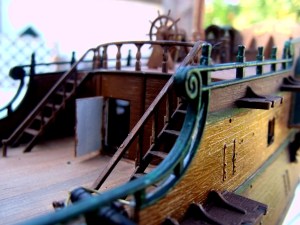
Phineas has survived Alfred Townsend and the dangerous boat trip to the Kathryn B. Seasickness almost did him in. Whatever could await in Chapter 4? Read on, good friend, read on!
MARIGOLD’S END, Chapter 4
The sunlight danced and twirled on the ceiling above where Phineas lay in his hanging cot. He looked at the squiggling patterns for a long time, trying to figure out how they got up on there on the underside of the floor above him.
What day was it? He couldn’t remember. His days had become a blur as he lay in the cot, sweating and retching and hoping that, if he couldn’t just feel better, he would simply die and end the misery of seasickness.
Uncle Neville came in to check on him regularly during the day, and of course slept in the other cot in the cabin at night. He had stood by the side of Phineas’ cot and clucked nervously.
“You’ll be right as rain before you can say Bob’s your Uncle,” he said once. He meant it to be helpful.
“I don’t have an Uncle Bob,” Phineas groaned. “Just an Uncle Kidnapper.”
“It don’t seem like it right now,” Uncle Neville replied defensively, “but this voyage will make a man out of ye. And a right fine man you’ll become. Just like your father.”
Phineas turned his head away and looked out the window. Just like his father. He shook his sick head.
“I just want to die,” he moaned in answer.
“I, uh, I’ll fetch ye a new bucket,” Uncle Neville said and left the cabin.
Later – it seemed much later to Phineas – it seemed the wind had picked up and howled around the ship.
Except that the ship wasn’t a ship anymore, but the fortress he and Nigel had built on the shore of Wharf Creek. Except that it wasn’t exactly the same. Torches guttered in the howling wind, and rain slashed and splattered all around him, although both he and Nigel were perfectly dry.
“I say, old tub,” Nigel grinned, “it seems as if we are in for a bit of weather.
“Quite so,” Phineas replied, and had begun to say something about the strangeness of no rain falling where they stood. But a sudden and terrible roaring noise interrupted him.
Where there had been rain slashing down outside the dark windows, now there rose the sea, deep green and surging, with white caps the size of horses.
“It will be all right,” Nigel called. “I’ve rather discovered a boat!”
He pointed cheerfully at a skiff – it was the one that belonged to Phineas’ father – sitting on the floor of the fort. “A natty craft, that one!”
Phineas stared at the thing in horror. The boom, the one that had so nearly killed him, swung menacingly.
“I don’t think…” he began.
“It’ll be all right, old wallop,” Nigel said. But he suddenly pointed out the window.
The sea burst through it and into the fortress like a green, white-capped tongue. It whipped its foamy tips at the boat and utterly destroyed it. The foamy tips lunged at Phineas, who leapt aside and ducked behind the boat’s wreckage. The tips spattered against the wall where he had stood.
Nigel stood in the center of the room, staring open-mouthed at the water that writhed around the room like a foamy green serpent.
In an instant the water collapsed in on itself, trapping poor Nigel in the center.
He thrust his hand out of the water, just inches away from Phineas as the water lifted him off the floor.
Phineas stared at Nigel’s hand, unable to move, frozen in place by his fear of the water.
“Help me,” Nigel called in a perfectly clear, perfectly calm voice. “You can do it, old shoe.”
Phineas shook his head. He could not do it.
The sea suddenly reversed itself, sucking out through the window, leaving the room in shattered silence. The sea was gone, Nigel with it, and the rain returned. Poor Nigel, he thought.
He sat upright suddenly in his cot – so suddenly that he bashed his forehead on the deck beam above. The impact knocked him backwards against his pillow.
Some time later he awoke again. Sunlight poured in through the cabin windows – his eyes ached under the glare. The inside of his mouth tasted like it had a dead rat in it. He was monstrously hungry. Uncle Neville had brought him some sort of dry bread, but he threw it up almost as soon as he swallowed it.
Nigel was still in his thoughts, and so was that surging, rapacious sea. He sat up in the cot and looked out the windows at the cerulean ocean. It stretched endlessly away, calmly surging under a gentle breeze.
“I still hate you,” he whispered to it.
A wave of nausea lifted in his gut, but just as quickly receded.
He thought about Duxbury, and Mother, and all that had happened. There was nothing he could do. He couldn’t go home – just look at the horizon: no land in sight.
“So,” he said softly, “I’m to be a sailor now, is that it?”
He was a to be a sailor who had very nearly shot Alfred Townsend. That was a pretty brave thing to do. He was a pretty good binding stitcher, too. That was a grownup thing. He was through with Nigel, which was a good thing. And he didn’t have to get up before dawn to go down to Mr. Santorini’s. That was a good thing, too. Maybe, if he avoided that Lourdburton, this sea voyage thing might not be so bad – as long as he stayed out of the water – maybe it would work.
He stood up carefully, somewhat cheerful, ready to try out the idea of being a sailor. His anger at having been abducted, at having his whole world jerked out from under him, at his being forced to ride in a boat, that would all have to wait.
“Phineas, lad,” Uncle Neville crowed as he strolled into the cabin, “glad it is that I am to see ye standing up. Get yourself up to the galley. Solid food is what you’re needing now.” The older man sat down with a humph on the cushions and pulled a chart towards himself.
Phineas looked at him for a moment, wondering if there was to be any further conversation. But his uncle had busied himself with the brass dividers.
“Uncle, if you please, what does kissing…”
“Captain, if you don’t mind,” Uncle Neville interrupted absently.
“Oh, of course. What does kissing the captain’s daughter mean?”
“It don’t signify…” the captain muttered under his breath, but then looked sharply up at his nephew.
“What did ye say? Kissing whom?”
“Kissing the captain’s daughter,” Phineas repeated.
“Kissing the captain’s…” Uncle Neville repeated in thought. He stared up at the deck beams above him, and then down at the desk. He pursed his lips and shook his head slightly, the little curls on his wig dancing to some unheard tune.
“Well, it’s clear I don’t have no daughters,” he said with a sigh. “I’m thinking maybe ye’ve confused it with kissing the gunner’s daughter, which is an old navy term for punishment on the gundeck.”
He looked back at his charts, moving the brass dividers across them once more. The black feather of his quill pen bobbed as he made small marks on the chart.
“There,” he said proudly to himself. “That’s as good a sounding as ever you’ll get.”
Phineas watched him, unsure whether he should ask more questions or go to the galley. In fact, he wondered if he should ask his uncle where the galley was, as he had no clue as to even what it was. Out came another chart, this one rolled up in a scroll, to lie on top of the first one. It didn’t want to lie out flat, however, and rolled itself back up.
Another thought, even more urgent than hunger, leapt into Phineas’ mind. It had nothing to do with the captain’s daughter, or the galley, or hunger at all. It was much more urgent. He watched his uncle, waiting for a chance to speak to him.
“Oh, for mercy’s sake,” Uncle Neville muttered and laid his inkpot on one corner of the chart. He snatched up a spyglass from the window seat and slapped it down onto the opposite corner. The two remaining corners curled rebelliously.
“Cursed Stromwell charts.”
“Uncle, I mean, Captain,” Phineas blurted, unable to wait any longer.
Uncle Neville jumped with surprise, jerking the chart, which flipped the inkwell over. He leapt to his feet.
“My charts!” he bellowed.
He snatched up the inkwell and set it on its feet, scrambled to find something to blot up the streaming ink that meandered across the top of his Stromwell chart.
“Is there an outhouse…”
“Out!” Uncle Neville roared. “Get out! Use the gallery, ye simple-headed lumpkin!”
Phineas ran to one of the small rooms at the side of the cabin and made use of the hole in the chair. What a chucklehead, he thought to himself, making his uncle spill his ink like that. He should have remembered what the galleries were for. He shook his head.
When he left the gallery he found that Uncle Neville had left the cabin. The charts were gone, and it was hard to tell from the vague blue stain beneath the half-empty inkpot whether irreparable damage had been done.
He sighed. This was a great way to start being a sailor.
The bright and open waist, visible from the still-open cabin door, beckoned to him. He walked carefully past the heavy guns, nestled like big hogs up against the side of the ship, and out into the brilliant morning sunshine.
Sparkling green waves slithered past as the ship surged through them. Wind hummed through the rigging, filing the big white sails that made an exquisite contrast to the blue cloudless sky.
“Mornin’, young fella,” said Swede as he passed on the deck. “Gut to see you about.”
“Mornin’,” Phineas replied. “Are you feeling better, too?”
“Oh, ya,” Swede replied. “I vas better two days oot. Alvays is same at de start of a yourney, ya?”
“Ya,” Phineas said. He liked speaking the international languages. Swede chuckled briefly, but suddenly stood up stiffly suddenly and glanced over Phineas’ shoulder.
Phineas turned around, trying to figure out what made Swede act so strangely. It was Lourdburton, nearing them as he walked purposefully towards the front of the ship. He glanced at Phineas.
“Well,” he said gruffly, “back amongst the living, eh?”
Phineas looked around awkwardly, not quite sure what to say.
“The typical answer is ‘aye, sir,” Lourdburton said tersely. “It’s a phrase ye’d best become accustomed to. When ye’re ready, you’re to report to Mr. Duffy in the galley to assume your duties. Is that clear?”
“Duties?” Phineas gaped at him. Lourdburton shook his head.
“No one sails for free, Phineas. Don’t forget, you are the cabin boy.”
He nodded and pushed past them as he continued his walk forward. Phineas stared after him. Cabin boy, indeed.
“The typical answer is ‘aye, sir’,” Lourdburton called over his shoulder.
“Aye, sir,” Phineas replied meekly. Swede shook his head sadly.
“You had best get forvard and check in mit Herr Duffy,” he said. “I vill be hongry when de dinnertime comes, ya?”
“What do you mean?”
“Der cabin boy is de one who is service the meals,” Swede answered cheerfully. “Dat is vat you is to be doing mit Herr Duffy. You best be getting’ up dere now, ya?”
“Aye, sir,” Phineas said.
“Yew don’t say dat to me, ye idiot!” Swede laughed. He trotted across the waist and up the ladder onto the foredeck. In a moment he was gone, climbing like a monkey up the ropes of the front mast.
Phineas glanced over the side of the ship. The deep green sea seemed so clear that he imagined he could see a thousand feet down. The ship’s shadow at once rose and fell on the waves and drifted like a dark ghost below and next to it.
He suppressed a shudder, and fought Nigel out of his mind.
Another shadow, smaller than the ship’s darted beneath them. His heart stopped. Something down there, in the deep green sea, moved. It wasn’t a shadow – it remained steady and constant beneath the dancing sun sparkles.
A pale gray thing, looking like a positively enormous linen tablecloth, drifted up from far down below them in the blue-green depths. It slowly rose up from the very deep water, starting first as a blur, but getting more and more distinct as it got closer. The thing was easily as long as the ship. Soon Phineas could clearly make a long whipping tail. It rose and rose towards him. He began to tremble, horrified by what he saw but unable to takes his eyes off of it.
It rolled over near the surface and stared at him with an enormous, black eye.
Phineas gasped and backed away from the ship’s rail in panic. He bumped right into a pudgy sailor who had been passing.
“What do you see, lad?”
The sailor smiled at him as if he was speaking to some village idiot, but Phineas didn’t care. He pointed over the side in horror.
“L-L-Look!” he stammered.
The sailor looked over the side. The horrid thing was still there. It glided smoothly, evilly, through the water below them, hiding in the shadow of the ship. Waiting for them. The sailor chuckled softly.
“Jablonski,” another sailor said as he walked past, “old man Sturgis is looking for ye, forward.”
“Thanks, mate,” Jablonski replied.
Phineas tried to look casual, as if he weren’t terrified of that awful beast lurking beneath the ship. He looked into the ropes overhead. The second the other sailor had gone he threw himself back to the rail to stare at the monster again.
In the blink of an eye the awful thing darted right to the surface and leapt fifteen feet out of the water. Its huge, gray, diamond-shaped body completely left the sea and whipped a tail that must have been ten feet long.
The beast lunged directly at him.
“He…help!” Phineas gasped.
A thousand gallons of seawater surged at him. The light gray belly of the beast slammed against the gunwale, throwing him backwards off his feet.
The slimy, fish-foul breath of the thing blew in his face as it perched there on the side of the ship for a brief moment. Men yelled and thundered towards it.
An inrush of breath, and the beast fell backwards off of the side, crashing into the sea with a titanic roar of water. Seawater fell about them like rain as the giant monster made a circle beneath them and disappeared, gliding smoothly back into the depths from which it came.
“I never seen the like,” one sailor said.
“When I was in Larkspur one landed clean on the deck once,” another said.
“Wha… what was that thing?” Phineas gasped from the deck. He was afraid to stand up in case it came back.
“Manta ray,” Jablonski replied with a grin. “Right frisky, that one.”
The grin, which made Phineas feel like a foolish little kid, also made him just the littlest bit angry.
“I thought it was going to eat us!” he replied. He instantly regretted saying that – of course the thing couldn’t eat them all.
Jablonski laughed.
“Goodness no, boy! That’s a manta ray. They don’t eat the likes of you and me.” He laughed and shook his head. “’Eat us’,” he repeated.
Phineas searched his memory for a reference of somebody being eaten by a fish, hoping to show this pudgy fellow that he knew more about the sea in his pinky finger than Jablonski did in his whole… anyway.
“Just like the story of Jonah…” he said.
A look of panic suddenly came over Jablonski’s face. He reached down and shushed Phineas with his hand. Phineas wriggled beneath the grubby fingers pressed over his mouth, unwilling to put up with any more insults. He climbed angrily to his feet.
“Now, see here…” he began.
But Jablonski looked over his shoulders in fear.
“You don’t ever say that name on board ship, lad,” he whispered urgently. “You just don’t say it.”
“Why not?” Phineas spat angrily. “Wasn’t he swallowed by a whale?”
“Aye,” Jablonski replied quietly, as if telling a great secret, “that he was, but that don’t be the whole of it.” His bright blue eyes shone out of his tan, stubbly face. His breath smelt of rum and tobacco. “God told him to go to Nineveh, see, but he refused, and took passage on a ship sailing in the opposite direction. So God took out His wrath on Jonah’s ship. He were just a passenger, but that didn’t matter to God. The sea rose up and tried to smash ‘em, and there was thunder and lightning, and the ship was bein’ tore apart. Don’t you see?”
The sea raced into the fortress in Phineas’ memory.
“Help me,” Nigel had said so calmly.
Phineas shuddered.
“I don’t see,” he answered quietly.
“When things go bad on board a ship,” Jablonski whispered, glancing around him, “it’s usually because you have a fellow who’s been cursed by God with bad luck – a Jonah.
“A man like that on board can kill a ship. You don’t NEVER want to go around sayin’ that name!” He looked around briefly to see if anyone had overheard their conversation, and then stood back a half step. “Do you understand?”
Phineas nodded nervously. This talk of the sea rising up, of God’s wrath for doing something bad… maybe that fish was a sign. Maybe God was coming after Phineas because he didn’t…
“But that’s not fair,” he blurted. He couldn’t have rescued Nigel – the water was too rough. Everyone said so. Maybe everyone but God. He looked down at the deck.
“T’aint nothing fair about it, lad,” Jablonski said simply. “God struck out at Jonah, and that is fact.”
Phineas glanced around the ship quickly. Maybe the fish was a sign. Maybe he had already brought bad luck on the ship. He looked pleadingly at Jablonski.
“Is – is it too late?” he whispered.
The older sailor put his hand to his jaw and thought for a brief moment.
“I don’t know,” he said quietly. ”Once one of them rays leapt clean through the backstay… Lady Ella, that was… during a right blow. The foretopmast come down an’ three poor sailormen lost their lives. I seen that, once. This weren’t as bad as that, but you just can’t know for sure. You surely do not want to go around proclaimin’ yourself a Jonah. If you do, and we run into a stream of bad luck, the crew will throw you over the side.”
Over the side. Phineas nodded slowly, sadly. Perhaps they would throw him over the side. “What should I do?” he asked.
“Well, we’ll just keep this atween you and me,” Jablonski said, looking around once more. “You din’t mean northin’ by it, you just din’t know. But don’t go sayin’ that name ever again, do you see?”
“Thank you so very much,” Phineas whispered quietly.
“Don’t ye worry on it,” Jablonski replied with a wink. He turned and walked cheerfully away.
Phineas watched the sailor walk away and wondered if this was some sort of circle: perhaps the sea was going to get him after all. Perhaps he should have drowned that time with his father. Maybe God sent that log for him, and Nigel got in the way. That bright, sunny day swam back into his memory, and water rushing and roaring and poor Nigel, his arm waving frantically above the surging waves, flailing…
“Phin, me boy,” Uncle Neville intruded cheerfully on his thoughts. “The galley is forward, not aft.”
Phineas looked up at him in surprise.
“I’m sorry about the ink pot,” he stammered.
“Don’t ye worry about that, now,” his uncle replied with a smile. “‘T’was me own fault.
His uncle glanced covertly about. He scratched his head, looked down at himself, and then motioned Phineas to come closer.
“Now, listen, lad,” he said softly. “It’s just that, well, it’s…it’s about them breeches ye be wearing. They, uh, well, they’re likely to be causing a bit of a stir amongst the men.”
Phineas looked down at his breeches. He had on his buff ones with the white stockings. Although soaked with seawater, they looked all right to him.
“I got splashed by a manta ray,” he said defensively. “I’m sure they’ll dry out.”
“No, no, it aren’t that. Goodness knows we all get wet most often,” Uncle Neville said with a little choking noise. His face turned an uncomfortable shade of red. “Look around you, lad. How many men do you see wearing breeches and stockings on board this ship?”
Phineas looked around. Not a one, not even Uncle Neville. They all wore trousers.
“It isn’t that you don’t look sharp and all,” Uncle Neville said, “but it causes a problem with the men. See how they all got them blue and white stripe shirts and white ducks? They’re all dressed the same because they’re members of the crew. You’re a member of the crew, aren’t you?”
“Well, uh, I, uh, don’t know…” Phineas stammered. The recent brush with death clouded his thoughts.
“Now, Phineas,” Uncle Neville said seriously, “your mother and I agreed that taking you to sea would be the best thing for you. We both know that having your father not be around, so to speak, well, it hasn’t been easy on you. Living there, in that cottage with my sister and no man around, well, it just don’t be right for a fine youngster.”
Phineas cleared his throat uncomfortably. He bit back the urge to point out that Uncle Neville must have felt that kidnapping a youngster and dragging him off to sea against his will was more right than leaving him at home.
“But, well,” his uncle continued, “here we are at sea, and I’m thinking things will work themselves out aright. You’ll find that this is the best thing what ever happened to ye.
“Now, son,” he said even more quietly, and leaned in closer to him. “There is one thing I’ll be asking of you. You’re me nephew and all that. But on board ship I need you to do your best, to be the best sailor you can be…”
“I’ve already decided that I would be a good sailor…”
“…The fact of the matter is that I always figured this ship and all her trappings would someday come to you, by way of inheritance. Just think of it, lad – your own ship!”
“…because that is what you and Mother want. It won’t be that hard, and I’ve already learned some terms… “
“… but, I need ye to do me proud in front of the men. You know, family tradition and all. Learn what’s taught to ye and show ye know it well. Put your best foot forward. Can ye do that for me? For your dear old Uncle?”
“As I say, Uncle, I’ve already started learning some…”
“Grand!” Uncle Neville grinned. “Now, it’d make things easier for me if you went to the slop chest and found yourself a pair of ducks. Mr. Sturgis can make ‘em fit for you. Best find yourself three or four pair, as trousers tend to get tarred up around here.”
Until he said the word trousers Phineas had no idea what ducks were. “What’s the slop chest?”
“You’ll find it in the fo’csle in the carpenter’s shop, right across from the galley,” Uncle Neville replied cheerfully. “That works out nicely, don’t it? You be going up there anyway, aren’t ye?”
“Well,” Phineas replied shakily, “I had rather planned on going back to the aft cabin…”
“Nonsense, lad,” Uncle Neville said cheerfully and clapped him on the shoulder. “Unless, of course, ye has business to do out in the gallery, but ye’ve already done that, eh?
“There’s the lad,” Uncle Neville continued with a smile. “You can pass my respects to Mr. Duffy and tell him I want him to make an easy day of it.”
“All righ…I mean, aye, sir,” Phineas replied. “Uncle?”
“Aboard ship I prefer to be called captain,” Uncle Neville said kindly.
“All right…captain,” Phineas said. “Have you ever heard of a Jonah?”
Uncle Neville looked at him suddenly with a keen interest. He glanced over his shoulders and stepped closer to his nephew.
“What makes ye ask that, son?” he asked seriously. “Do we have a Jonah amongst us?”
“Well, no, I was just…” Phineas began.
“Who is it, son?” Uncle Neville asked urgently. “Point ‘im out to me if ye don’t know his name.”
“Well, I was just…” Phineas had been going to describe his conversation with Jablonski, but Uncle Neville’s reaction suddenly made him nervous. “Uh, I just heard someone saying that they didn’t think we had any Jonahs aboard this ship.”
“Well, you just tell whoever it was that you overheard that I’ll not brook even the mention of that name aboard my ship,” Uncle Neville said severely. “Now, get yourself up to the galley and we’ll put this nonsense behind us.”
Uncle Neville turned to leave, but then turned back again. He dropped his voice.
“Now, Queen’s truth, you didn’t hear no tell of there being a Jonah aboard the Kathryn B?” he asked in a low, urgent whisper.
“Queen’s truth,” Phineas replied
Uncle Neville looked at him for a long moment. It was an odd look, as if he didn’t believe him, or didn’t trust him, or was, perhaps, just afraid. It made Phineas squirm.
“I imagine I should head to the galley,” Phineas said.
Uncle Neville nodded.
“And no more of that kind of talk,” he said as Phineas passed.







 John D Reinhart