You noticed in my last post how I cleverly mentioned the name of my second novel, DROPPINGTON PLACE? Well, did you notice that I just mentioned it again? Boom. Right past you, there, huh? That, my friend, is marketing.
Well, actually, it’s not, because you are the only one reading this post. But, if I had, like, a million readers, boom… see?
Here’s another one: I put Chapter 14 on MARIGOLD’S END, my first novel, on the Pages part of this website. Huh? Did you see that? Huh? Right there. Boom.
The theory we’re testing here is exposure. Repetition. Repeating the name over and over. If you look over my posts, you’ll see a preponderance of pirate pictures. Ah, another part of the theory.
If the theory of repetition holds true, when I finally get MARIGOLD’S END pried out of the hands of my stalled editor and published, there will be a line of people waiting to buy it. It will virtually be a line… or maybe a virtual line. Maybe a hypothetical line. Maybe a line of one. Me.
But that’s the gamble of marketing, upsides and downturns. Read the chapter. Leave a comment. Boom. You are marketed.
Go ahead, say what you will. Get it out of your system. Shameless, tasteless, bad form, bad ‘cess to it. Fie on thee. There you go. Are you through?
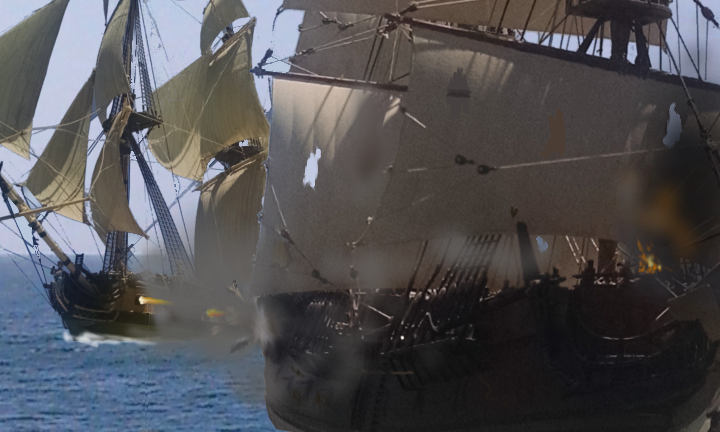
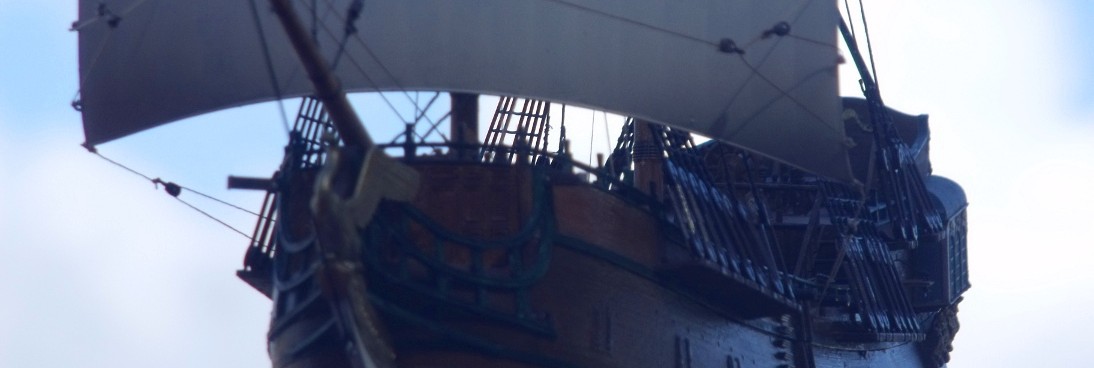
The cause of this invective, as you well know, is that I put together a cute little video about a model sailing ship, announcing its YouTube launch on a sister page, Droppington Place.
Nobody watches it, but, well, as you’re the only person reading this post, low ratings are no shock to me. Rather a low par for a very lonely course. You’re a writer. You know how it goes.
So, there were some little cranky-making nits and gnats in the movie – not enough to stop a would-be Steven Spielberg like myself, but perhaps enough to make a would-be watcher say dude, what was that?
Although no one has watched the move, there is still the profession to be honored. Plus, one never knows.
Hours under the cinematic hood resulted in this: TA DA!!!
Hey, you say, I didn’t watch the other video, but this video sure looks the same.
You, my hyper-critical friend, are only halfway right. Yes, the majority of images are the same. But, there are some pretty big deal changes.
Some of the images are taken from other photography sessions – one shows even an incomplete ship. Ho HO, did not see that coming, did ya?
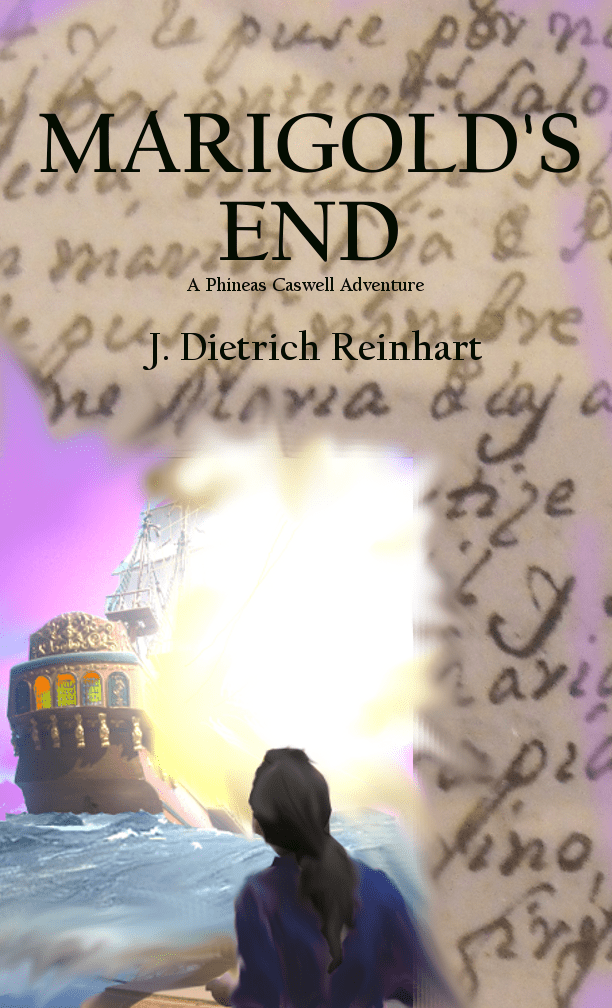
But, here’s the shameless marketing part – one of the images, a 7 second segment, shows the cover of my novel, MARIGOLD’S END. The cover features the same ship model, dramatically blowing up in the background.
Genius, I know.
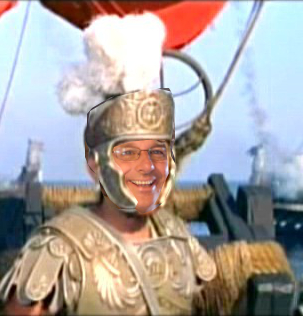
AND, if you look carefully at that one shot of the crew on the deck, some joker cleverly inserted the face of yours truly in the background. Oh, so clever.
Say what you will, this is a great example of cross-platform marketing.
If somebody ever watched my video, they might wonder about what that dramatic book cover is.. about… and Google MARIGOLD’S END, and, bang, zoom, the circle remains unbroken.
Not only that, but the casual reader of Droppington Place, and there is only one of those, now has a link to the video, which leads back to the book. Ah, the web, the web…
Obviously, with only one reader and no video watcher, the full effect of my marketing tour-de-force has yet to be felt. But give it time…-150-200 years or so, and then we’ll have something about which to converse.
If you’ve been reading the chapters of my book, MARIGOLD’S END, you’d know that I’m releasing it one chapter at a time onto this site. You could figure it out by reading my posts, of course, including this one, but I’m trying to make you thing “dude, I should be reading that book instead of playing Candy Crush Saga.”
Not that I have anything against Candy Crush Saga – in fact, I’ve given up all on-phone video games for Lent – or your reading habits. None of my business. Nope. Nosiree Bob.
So, there it is. Where is this going, you wonder. And well you should, for I do, too.
Here’s where: Chapter 5 is now on the site. My boy Phineas, 12 years old in 1706, is taken to sea against his will by his seafaring Uncle Neville. He’s had a narrow escape with murder (committing it), nearly been drowned, suffered through near-terminal seasickness, and now has learned about the superstition surrounding a “Jonah.” Ah, but the deep blue sea holds more adventure for our young man – he’s about to meet Taylor, a slightly older, terribly well educated sprout of a fellow, and Louise, the granddaughter of the King of France.
If you aren’t reading along, you’re missing out.
And don’t be expecting me to come on here and tell you the whole darned story – not going to happen, mate. Nope. There’s a big ending, but I can only hint about that.
Here’s the hint: it’s big. Another hint: it’s at the end.
You’re a writer. You know how it goes. The world doesn’t necessarily come looking for your book. You have to coax it, wheedle a little here and there, to generate interest and talk. Buzz. You gotta build the buzz. Sounds like a bumper sticker.
Your publicity should be gentle, but persistent. Nobody likes a showoff, and most people don’t appreciate self-aggrandizing fanfare. So you have to be nice, and, like me, terrifically humble. Okay, brilliant is in there, too. Did I mention brilliant?
You don’t have to read my chapter, but take a page from this forum (as you know, only the humbly brilliant refer to their soapboxes as forums) and think about being nicely, humbly persistent in publicizing your work.
Notice that the word ‘marketing’ hasn’t shown up anywhere in this…oops, there it is… because you and I, we no longer market our work. We publicize it.
Good luck in your publicizing efforts, enjoy the chapter, and be nice.
Are you ready for the next installment of MARIGOLD’S END? I’ll bet you are – you there, my writer friend, sitting on the edge of your seat wondering, wondering, wondering whatever happens to Phineas next.
At least, I hope it’s you. Nobody else in the room, that I can see. Yep. It’s you. Try to form a line there, would you please? A line of one rather resembles a dot, doesn’t it? Well, please form an orderly dot.
Writing is a lonely business. Your garret, or office, or room, or swimming pool deck, wherever you do your writing, fills up with characters, talking, laughing, fighting, sleeping, doing whatever it is that they do. Then you turn off the word processor, and, voila, it is only you.
No one is very much interested in you while you write, because, frankly, you are uninteresting when you write. Not as a person, mind you, but as company, because you’re in the room filled with all those interesting characters. The real people around you just sort of hang in limbo until you snap off the word processor. Oh, THERE you are!
So you, my dotted friend – dotted by virtue of being a line of one – are the witness to the publicity and hoorah surrounding the release of Chapter 4. Hoorah!
Chapter 4 introduces us to the life of a sailor. Chapter 1 introduced us to Phineas, Chapter 2 to the perils of traveling by boat in the early 1700’s, and Chapter 3 to the indescribable job of seasickness. Now we’re past all that and exploring the Kathryn B, and what it means to be a sailor.
In MARIGOLD’S END, you learn about the new world into which Phineas is thrust only through his eyes – a challenge to write, but hopefully not to read. Like you, Phineas’ learning comes through total immersion. It be sink or swim in the briny deep. You’ll find it over there, on the left, under MARIGOLD’S END, the Novel. See, it sort of drops down, ready for reading’!
So you, dear dot of a writer-friend, are in for a treat.
Let me know what you think. Drop me a line, leave me a comment, send me a mental note.
If you are a new dot, please be so kind as to stand next to the other dot, thereby forming a line.
Okay, no lies here. Only the straight up truth. Something inside says to publish the chapters of this book, one miserable week at at time, until the book is laid completely before you. So, submitted for your approval, MARIGOLD’S END, Chapter 3. You’ll find it over there, on the left, under the title MARIGOLD’S END, the Novel. See how it works?
So, why publish chapters of the book. Once you’ve read it, you’re not likely to buy, like, a dozen copies. Maybe you could – they make great Christmas presents and passable doorstops – but no one is holding their breath.
No, it’s something more fundamental than marketing. What is the WWW if not the marketplace of the world. What is the Internet, and the ability to publish whatever, whenever, if not a way to float ideas, to share thoughts, to trade our works of art with one another?
In Shakespeare’s time, he published his own work through a publisher, hoping that it would sell. But more than just hoping for a little quick cash, a little Elizabethan jingle-in-the-jeans, he had to write, had to publish, had to share his words.
You’re a writer, you understand. You do the blog thing as a way to express yourself.
More, this is marketing. While I want you to read this book, and DROPPINGTON PLACE, my next book, I really want to impress in your mind that my books are good and entertaining and worth the paltry shekels one shells out for them. I’m not marketing these books, but their children.
Which, according to gorilla marketing, means I’m not marketing at all, but publicizing. You, John or Jane Q. Public – isn’t it weird that John and Jane have the same middle initial? It must be Quincy – are not being marketed, but are reading a fine piece of publicity. No pictures, please.
So, go on over and click on MARIGOLD’S END, the Novel, and breeze through Chapter 3. I hope you enjoy reading it as much as I enjoyed writing it.
When we left our heroes, Norman, Jake, and Wanda dangled over the boiling lava pit, suspended in the air by a single strand of dental floss.
“I believe it’s beginning to stretch…” Jake gasped.
The cliffhanger, the white-knuckler squeaker of a nasty dilemma that makes you just want to, makes you just have to, makes you just DIE to start the next chapter and see what happens, is an old, old way to sell stories.
Scheherazade used them to keep herself alive in the One Thousand and One Nights, remember? The king was going to lop off her head when she reached the end of her story, so she spun out cliffhangers, night after night, until he finally said “dude, like, cut it out!” That may be a loose translation.
The upside of cliffhangers is that you bring the audience back for the next chapter. It’s rather a component of gorilla marketing, wherein you don’t do anything, and let the story do all the work.
The downside is that your story becomes lurchy, if that’s a word, and rather roller coastery, if that’s a word. Your sensitive love story about a girl and her pet dragon must necessarily take a turn for the violent, or for extreme emotions: I HATE you, Nogard bellowed. The end.
Another downside is that cliffhangers become rather tedious. For goodness sake, can’t he AVOID the traps once in a while? The old Batman TV show had just 22 minutes to get out of a cliffhanger, tell some story, and get into a new one, making the Caped Crusader seem, I don’t know, rather cartoonish?
So, it is with a blend of cliffhangery, if that’s a word, and gorilla marketing, that you now find Chapter Two of MARIGOLD’S END here on this very site.
Taa Daa!
As you’ll recall from Chapter One, our troubled twelve-year-old, Phineas Caswell, points the loaded pistol, trigger-finger itchery (if that’s a word), squarely at the running-away back of Alfred Townsend, the unarmed bully that has made his life a living hell. Will he pull the trigger and end his woes? Will He? WILL HE???
Well, now you can find out. The second chapter, cleverly titled Chapter Two, now has it’s own page. Oh, and you’ll be surprised at the turn of events. I hope.
Now you can read the chapters, build up steam, get rolling in MARIGOLD’S END, and wait breathlessly for Chapter Three. Oops – I gave away the title!
Before you get all wormy-squirmy and palm-sweaty like you do in the seat across the car dealer sales manager (How am I going to get you into that car today, friend?), I must remind you: this is gorilla marketing. Don’t buy the book – you can’t!
But, let me know what you think, would you? Liked it? Hated it? Mondo disregardo? Your feedback, my independent writer friend, is most needed.
Now, I’m not desperate – I know that’s what you’re thinking. But, I’m not, I’m not, I’m not. My darling editor is moooviiiing soooo slooooowly, think of this as Plan B.
Your input, spread out over the number of weeks over which I plan to release a chapter…let’s see, here, 18 chapters, take away the 2 I’ve already released…let’s see, carry the 1…should coincide with her completion of her editorial chore.
Badda boom, badda bing, and all I have to do is NOTHING! Now THAT, my reader friend, is gorilla marketing!
Don’t you hate those people who sum up their lives in, like, fifteen seconds? What do I do? Well, after I graduated with my MBA from Dogsnorton University, I became the sales manager for Incredible Products, the premier manufacturer of sodium-hydroxide based whisk-broom filaments with offices here and in seventeen other countries. Perhaps you should look into purchasing sodium-hyrdoxide whisk-broom fliaments. Your first thought: don’t these elevator doors ever open?
On the one hand, it’s nice to know what that person is all about. On the other, an elevator pitch invariably leaves you standing there saying “uh, well, huh, how about that?”
Sadly, this must become you. Wait, don’t go! …well, go if you must. But hurry back.
The fellow making his elevator speech to you is showing you a sign, paving your road, mentoring you, yes, you. Instead of muttering “you’re ticking me off, Phil,” you should take a mental note. Use a pencil if you have to.
This person is showing you how to market your book. He’s not exactly granting you permission to be annoying and mono-focused, but he is giving you a great example of how to sell. His elevator speech is guiding you in creating your dustcover speech.
When you buy a book, you don’t just read the front cover. You flip it over and read the paragraph on the back of the dustcover to see if the book has more than just a cool picture to recommend it. That guy’s elevator speech is his dustcover paragraph.
Here are two dustcover paragraphs on my book, MARIGOLD’S END:
The deep blue sea has haunted and hunted twelve-year-old bookbinder’s apprentice Phineas Caswell ever since it took away his best friend and his father. Now, shanghaied aboard his uncle’s ship, the Kathryn B along with his new-found friends Louise and Taylor, he must face pirates, storms, and the secret of nations as he learns the meaning of trust and the value of responsibility.
…and…
Everything happens to twelve-year-old bookbinder’s apprentice Phineas Caswell: his father and best friend are taken by the sea, he’s beset by bullies, and he’s dragged off to sea by his uncle. But, after learning the ways of sailors, after battling ruthless pirates, facing storms, and even determining the fate of nations, he realizes that life is not what happens to you, but what you make it.
So. Which book would you buy? – I’m sorry, “neither” is not a valid option. I’m still trying to decide which of these best describes not just the story, but the style of the book. Like the elevator speech, how you say what you say says what you need to say, too. Well, I say!
The second book sounds like more fun, but the first book might teach you more. I haven’t figured out which one I like yet – your input would be appreciated before you leave the elevator.
So, go out there and practice your dustcover speech. Who knows? Someday you might be on an elevator, and someone might ask what you do. You turn to them and say “Everything happens to twelve-year-old bookbinder’s apprentice Phineas…”
At eighty miles an hour, hauling bananas down the freeway, the steering wheel of your new Yugo pops off the column and into your lap. Turns out the factory hadn’t quite gotten around to tightening the steering-wheel bolt. First, it’s a miracle your Yugo can go that fast, but, most important, you rather expect the thing to be complete when you find it in the showroom.
So, bringing the book to market.
Instead of guerrilla marketing, which takes advantage of evolving market circumstances and opportunities to quickly and effectively advertise a product, I’m using a technique called gorilla marketing, which takes advantage of overall laziness and general inaction with a grudging commitment to minimal effort. The gorilla marketing maxim: how much can you get done without doing anything.
Gorilla marketing is certainly affordable, both financially and time-wise, although it may not be as effective as that guerrilla thing in getting a book to market.
But, guerrilla or gorilla, you gotta do one thing: finish the darned book. Finish. It. Cross all of the T’s, dot the I’s, and get it done beyond done. Spell check it. Grammar check it. Re-re-re-read it once more.
I am happy to have an utterly brilliant editor very close by. My wife has a master’s degree in Russian literature, is an avid reader, and, most important, a mother of three terrific kids.
In the best gorilla marketing tradition, I didn’t even bother to print the thing out, but simply emailed a copy of MARIGOLD’S END to her. I just hear the boop as it arrived on her cell phone. That’s really close to doing nothing about marketing my book.
Jackity-crackers, kids, we’re working now. Although she is perhaps the slowest dignity-danged editor on the planet, she’s really good at it. And the price is unbeatable!
She will clean my clock on just about every sentence in this thing, and will make me rewrite the stuff that just doesn’t make sense to her, and we’ll have approximately 27 arguments over why Phineas says this and not that.
But, at the end of it, the MARIGOLD’S END that comes out will be the cat’s underwear.
So before I sent it to my editor, and in order to bring the number of soon-to-be-coming snarky comments to a bare minimum, I had to spell- and grammar-check it one more time. Found a couple of things I’d missed – who knew? The grammar-checker challenged my sentence structures – fie on thee, grammar-checker! Anyway, it’s done, and the missus has already said she regrets taking on the task. Cool!
Back in the good old days, before color TV, rulers declared themselves despots, and tossed out anybody who didn’t agree with them. Those disagreers were labeled “vile betrayer”, and, boom, off they went to the desert on good days, off went their heads on bad.
“Be gone, vile betrayer,” was a pretty common phrase, back in the good old nasty despot days, so I’m told.
In marketing your book, you get to be a despot – a marketing despot. It’s a cool title, like those honorary doctorate degrees that colleges hand out to folks who chip in a bunch of money to build a new teacher’s lounge with a gymnasium attached. Except that this title has power to it.
For one thing, you can brand as vile betrayers those people who tell you that you should be writing with crayons. Be gone, vile betrayer. Or those who tell you they’ve read better material on the artificial butter tub. Be gone, vile betrayer. Or those who just simply tick you off – you there, with the white socks and Birkenstocks – you are worse than a vile betrayer. Be oh so gone.
As the marketing despot of your book, you have to have an iron will – or an iron George if Will isn’t around – to keep the success of your book foremost in your mind, in front of the windmills. You must cast out as non-believers those who don’t believe in your success, because, well, shucks, they’re non-believers – I guess that just sort of follows.
Why must you be so iron-willed (or Georged) despotic? Two answers:
You must be iron willed because you, and only you, are the champion of your book. If not you, whom?
You must be iron willed because faith is a tentative and fragile thing. And, really, all you have is faith that your book is marketable, is fantastic, and is something truly special. That it is your gift to the world.
The marketing guru chosen for MARIGOLD’S END turned out to be a vile betrayer. A non-believer. A nay-sayer. A neer-do-well-cad. A nervous Nellie. Be gone, vile betrayer, and take your encyclopedia-selling mindset with you. Be thankful you’re not banished to… to… well, banished! Be gone!
This is your chance to be the ruler you’ve always known you should be. YOU can take your book to stellar heights. YOU can build a literary empire. YOU could RULE the WORLD!!!
Or, maybe you should just concentrate on selling your book.
Nothing beats a good hissy-fit. You know the kind, where you pull your hair and stomp your feet and get so red in the face people think you’re a thermometer? That’s a really effective way to scare off bears and stray pussycats. I tried it at the office… not so effective there. I guess I can sort of kiss that raise goodbye.
But a wild hissy-fit might just be the thing that puts your book over the top. What would happen if, like, you started getting into the world’s grille about something – racism, climate change, dirty diapers, you get the drift – and made some sort of a big hissy-fit. Your fit gets on YouTube, you go viral, and, oh, hey, you also wrote a novel that now we all have to read because, goodness, what a vibrant person you are!
It could work.
Sadly, if you threw a hissy-fit over something really nice, like the West African success against ebola, you wouldn’t get any coverage at all because the world doesn’t work that way.
Sadly, if you threw a hissy-fit over the nastygram items listed above, you might get branded as a tantrummy sort of bozo, because that is the way the world works. Seriously, who wants to read a book written by a bozo, unless you are the REAL Bozo, and then, hey, that might be kind of cool. A book on clowns by the master clown himself – you could make it really scary…
Step One in the Gorilla Marketing Plan is to avoid Hissy-Fit Marketing (HFM), because it only garners negative attention. I get enough of that at work.
Step Two is to make things big, which is sort of a parallel to HFM. Make things big – broadcast yourself. Spread yourself out. Do LOTS of stuff, and tie it all together. Yes, it takes a little effort, which is anti-gorilla, but it simply has to pay off.
You are publishing your book online, right? What’s the magic word there? Nope, not bozo. It’s online, bozo. Search engines and crawlers and robots troll the WWW every single second, making links between this and that, him and her, it and, well, it. The more connections you have, the bigger you are.
You don’t stop dancing with the 600 pound gorilla when you’re tired – you stop when he’s tired. Dolly Parton wears those outrageous wigs to make her short little self not so much. Say what you will about the other parts of her, at least the wigs make her look taller.
So, no on the hissy-fit, yes on the broadcasting yourself all over the WWW.
If that doesn’t work, well, then, ding-dang it! What THE HECK IS GOING ON HERE??? WHATSA MATTER WITH THE DING-DANG STINKING WORLD…










 John D Reinhart