De-Energizing Anti-Inertia

Photo: HowWeDrive.com

Time rolls like a jelly-roll, right down the hill with the biological waste-matter, for we all know poop rolls down hill. That’s why your boss can give you dreadful assignments with such cheerful abandon, because poop lands on the desks of bosses with the express goal of rolling down the hill to your desk. If you are a boss, good on ya, mate, because you can roll your poop to the next level below. But I digress.

Time and energy are inextricably intertwined. Don’t think so? Why don’t you drive at 85 mph down the interstate when you’ve got six hours to get there…unless you are one of THOSE, who can’t drive 55… was that Sammy Hagar? Wasn’t he horrible? Or was that Hagar the Horrible, who drove too fast in the… but I digress.

What stands between you and your finished work – and by finished I don’t mean lookee there, Slim, I rot me a boook! – I mean a finished and produced piece that, if not published, is well down that road. In fact, let’s take it a half-mile farther down the road and say your work is not finished until it is published, and easily accessible by the world at large.

Wow. That’s a big goal. You took the time and heart and effort to write your book, didn’t you? Good on ya, mate! That’s your heart and your art, and, even though we tell our friends and admiring toadies that it was tons of work, you know in your artistic heart that it was fun. Go ahead, admit it. We probably won’t tell.

There was so much inertia to get the book done – day after tedious day (wink) of writing to tell the story, get those characters’ voices out there- be free, my creepy inner friends – with a single goal in mind: The End.

Publishing it. We-heh-heh-heh-ell, now, that’s just a whole new kettle of friskies, in’it? How do you do it? My proofreader moved on before he finished my book – well worth the nothing I was paying him, I say. An editor? An EDITOR? Those cost around a thousand bucks, my ramen-eating friend. And then, say we finally get the thing proofed and plop down half of the house payment and get it edited: crickets.

I came of age in the business world – you probably did, too. We know how to get things done, you and I. Mimeograph this, would you? Did you order more ribbons for the Selectric?   Can you smell the ditto machine? Publishing… oy, now, that’s going to use our business acumen, and other parts of the egg.

All the inertia is lost. A wide set of skid marks veer off the shoulder and into the bushes on the other side of the ditch. Maybe it’s off the road, or maybe it’s running down some hidden lane only the driver knows. Whichever way it’s going, it aint towards success.

The hardest part of this book-writing exercise is the now, right here. The thing is done, but there is nowhere to go with it. I’ll let you know if I get out of the bushes.

Stick a Fork in Me

Marigolds-End-Done

Done like a ton of finished, like a taco casserole in a thousand degree oven I am done, done as the day is long, done. Finito. Wrapped it up. Did the deal, finished across the line with a big ol’ smile across my face. DONE!

72,584 words of pathos, humor, and history all wrapped up in a nice little package featuring my friend Phineas, who gives up, gets angry, blows his top, cries, and finds his father, all the while fighting a running battle with the sea. Phin, my boy, carped at by the ship’s sailing master, driven to near distraction by the French king’s granddaughter, and called every harsh, rude, hurtful name in the book, tries to find his way, figure out how he got thrown into the seagoing gulag that is the Kathryn B.

Not a spoiler alert, not here – you’ll have to read for yourself how this one turns out.

In fact, my next step is to find a reader. Someone who can be honest with me, but someone who knows a thing or two or three about the Young Adult Fiction business, what they’re looking for, what will float, what will sink like a stinking stone.

Really, my next stop is on the publishing wagon. Get this monster read by someone with brains, rework it to their thoughts, and then Wordsmash it or Yahoo it or Amazon it or something.

Really, the next step, which starts tomorrow, is to think about marketing. Building the old platformaroony that will carry this book into the bazillion dollar sales range.

You, my friend, need not worry. I will not try to sell you a book. You are my only reader, and I thank you for sticking with me. Stay with me, sail with me over the horizon of the publishing adventure. I promise to tell you everything. The rewards could be great.

For now, the goal is to simply enjoy 72,584 words of doneness. Finitoness. Ah, sweet victory, thy name is Phineas.


The End of the World

It could all be whipped away from us in the very blink of an eye, this trusty old world of ours. I might not even be able to finish this post because the dumb old world ending thing might happen fir… st. If you’re a fan of Dr. Who, it almost happens every week.

On a totally different subject, my wife and I were talking about absolute cold… well, I was babbled about it and she was very nice… absolute cold. So cold that all of the heat is drawn out of the molecules, down to the quarks and their cousins falling to infinitesimally small particles of nothing, but not falling because there is no energy. No energy, no heat, but absolute cold. Maybe that’s the end of the world.

Or, maybe it happened today, when my daughter told me that maybe I should reconsider my book – you have a good idea, there, but maybe you should write it this way. Excuse me? Excuse me? Excuuuuuuuuse me? You’re my kid. You’re supposed to think it’s better than Gone with the Wind, for crying out loud. Maybe it would be better if…?

It’s not the end of the world, but, you’re a writer, you know how it feels.

This afternoon was supposed to be a nice editing session, powering through the last quarter of the book, reworking working sentences into elegant, beautiful descriptions of the human condition.

He pulled the trigger. The pistol exploded in fire and smoke. The pirate swore and ran for the ladder. Lah dee dah dee dah.

Maybe she’s right. Maybe I should sit down and write a book like J.K. Rowling, or Stephen King.   Yes, perhaps I’ll try that. Maybe I’ll just write version seven of this stupid book off as a whim, one that’s lasted a good six years, and do something else. I hear that wallpaper’s easy to hang. Taco Bell’s hiring.

It’s not the end of the world. But some simple conversations can cool your heart until the quarks cease their tiny orbits.

Now, I’m not complaining. I am sharing this with you, dear writer, because the day may come when a loved one delivers to you the blow that ends your world, your entire universe.

But you know that you’re good – you just have to hold onto that, because you ARE good, dear writer. And tomorrow the sun will come up and the absolute zero in your heart will thaw, and your muons will start their crazy dance, and life will go on.

And you’ll think about what you’ve been told, and you’ll put it into the salad bar of your mind, right next to the windmills, and continue your work.

See? It wasn’t the end of the world.

Creepy Little Voices

You know the line of jokes: the little voices made me do it, I only do what the little voices tell me, how do I know you are not just another little voice, etc.

So, rattle me this, Bidman: you’re a writer, right? You write dialog, right? In that dialog, your characters say stuff that sometimes surprises even you, right? So, like, where do those words come from?

Is not the character you’ve created exactly like a little voice in your head? Consider:

Bob:     You don’t even know my last name…

 Julio:   But I could, man! I’m telling you, we could be famous.

 Bob:     Julio, I don’t want the kind of fame you’re suggesting.

 Julio:   Aw, come on, Bob. At least think about it.

I just shot that little gem right there out of my head, unconsidered, unrehearsed, and un-edited. I know, I know, hold the applause.

So, like, where did it come from? The names popped up as I typed them, and the dialog followed along. In the first line I thought Bob might be talking to a girl, and I almost typed   Julia, but I didn’t like Bob’s tone. So Julio is proposing something that will make them famous, but Bob doesn’t think it’s a good idea. Boy, how much story can you get out of just four lines?

In the rule book for regular folks, How to Be a Regular Person, by Ima Sandwich, it says that the little voices in your head are bad. They are destructive, and not real.

But, if you write down what the little voices say, you could be famous. And not for, like, blowing up dams and stuff, but good things, like writing fine, fine art.

Alas, my little voices aren’t good enough for fine art. They come as the simple regurgitation of all the hundreds of thousands of lines of dialog and conversation I’ve read and heard over the last half-century.

But isn’t that what writing really is? Don’t you mish-mosh ideas together and come up with characters for your novel? Doesn’t Cyrus say something that sounds like something you’ve heard before? Or Ethel? Rodney? Ralf? Aren’t they kind of barfing up old conversations in new, and sometimes surprising ways?

An actor memorizes his words, but the feelings behind them come from deep inside him. He applies his five or so decades of experience to the character he portrays, even though he’s never had to face the character’s exact circumstances.

Dollars to donuts says that you are doing the same thing with your mightier-than-the-sword word processor. Especially if you write horror, and your characters say the creepy stuff that the media tells is what the little voices say.

The answer is probably that, because you don’t act on the little voices, you’re not crackers.

But, tell me you haven’t awakened in the wee small hours with a perfect line in your head: Jackson says “well, it looks like rain to me.”

Thank you, little voices.

Alert: Monster in the Cupboard (not Closet)

If you write a lot, but don’t get feedback, yours, my friend, is a lonely game. You toil away, fitting together the pieces of your written puzzle like so much cheese at the mousetrap factory, when, one day, the monster grabs you.

I am a miserable novelist. I just realized it. Not misery like in hey lady, that was my ANKLE thank you very much, but in misery as in whoa, dude, do you, like, know any words? How many ways can you say “said” without sounding moronic, he intoned.   Whimpered, whispered, hissed, murmured, muttered, uttered, grunted, yelled, roared, bellowed. Well, that’s it for me.

And that sentence structure, what’s up with that? He opened the door and looked inside as the tree fell through the neighbor’s roof. He drove the car and whistled a happy tune as the rain pattered joyfully through the open sunroof. He wrote the post and congratulated himself on at least writing something as he bored his reader (bless you, whoever you are) to tears. Subject verb the noun clause and verb a noun clause as noun verb preposition noun clause. Booooooooooooooring.

Maybe it’s because, as a technical writer, my is writing is limited to “attach the motor mount to the casting with (2) socket head cap screws.” It isn’t romance, but it pays the bills. While it’s easy to write “carefully place the hinged device against the casting and thread the screws, one-by-one, into the small holes”, my editor would hand it back to me faster than a greased bowling ball on Crisco Boulevard.

In truth, there’s something else going on.

You’re a writer – I ask you: who is your worst critic?  Go ahead and think, we’ll wait… do you need to make a phone call?

Of course it’s YOU, you ninny!

Except not really you, but the monster in the cupboard. I was going to say monster in the closet, but that now leads to coming out of the closet, which has a whole different meaning than what I was shooting for, and oh, now everything’s all tangled up. One moment, please…

So, the monster in the cupboard is your own self-doubt, self-fear and self-loathing (if you’re in Las Vegas), trying to sell you a bill of goods. I know it’s just a bill of goods because my daughter told me today that she likes my book better than Hunger Games. She might be bucking for extra allowance, but I’ll take what I can get!

The monster lives in the cupboard of your mind, next to the windmills, and sees the absolute worst in everything that you do. And it loves, Loves, LOVES to point it out to you.

Part of the monster is good. I mean, it’s the only one who makes you go back and polish that sentence once more – you know it needed it. It’s the only one who makes you question whether this book really needs this scene.

But the monster is also baaaaad, baaaad, because it can convince you that you are a miserable writer. You know it isn’t true, but the monster seems so authentic, so… so… so right.

You know that you are the monster – your parents said you were a little one when you were a kid – which means you can stop being the monster.

The next time you flop into a heap in front of your word processor, crying because you just aren’t good enough to write this book, and you really should not have quit your day job, and how could you have EVER thought that you could do this…well, you can just stop it with the Mr. Nastypants routine.

Nobody’s buying it, and you’re just being a whiney crybaby because you listened to the monster in the cupboard.

Shut the cupboard and get back to work.

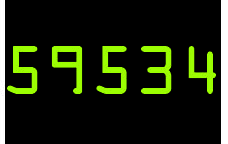
59,534 Words

59534

59,534 is a pretty big number. Way bigger than six, even fifty-six. It’s so big that, if you wrote it out in word form, well, you couldn’t put a postage stamp on it. Although, really, what with email, that postage stamp business is kinda getting old school. I mean, really?

But that’s not the point. The point is that 59,534 is a milestone – no, not a millstone, although one could make the argument that if you never finish anything, but simply count numbers of words, the writing of one’s novel could become the thing itself, and the poor novel would never be finished because really we’re just churning out words to be counted. Sad, sad.

But that’s not the point. The point is that I set out to rewrite this novel of mine to 60,000 words. I’m still a good 15,000 words from the end of the rewrite and I’ve hit 59,534. On the one hand you could say, gee whiz, you bozo, you didn’t hit the mark. But, on the other hand, you could say, dude, you like, totally obliterated the milestone. Shredded it. Like a cheap taco, you know?

Oh, and these are good words. Full of passion and verve, with only one passage so far that my daughter has pointed out as dullsville. I’m headed over to dullsville next week, taking the slow bus, to fix up things there. As long as she stays awake I’m good.

But that’s not the point. The point is that, as writers, particularly budding novelists – oh, how I hate that word “budding”. Makes it sounds like all you need is raindrops and sunshine and lovely windy days and, badda boom, etc., look mom, I produced a novel! Bud this. Novels are nothing but the results of blood sweat and tears, and more than a lot of all three of them except the blood part. They are hard, hard work that, even though it’s fun to write and when you’re in the moment there is nothing sweeter than your characters telling you what to say and what they see and you are really there, really in that place, the sweat dripping off your nose because the steam engine is just six inches away, and the smell of the grease fills your nostrils, and the bossman keeps bellowing “shovel, you lazy dogs!”, they are angst-filled folios cobbled together from hopes and dreams and genuine, genuine art.

But that’s not the point. The point is this: although nobody reads my stuff – if your are reading this, be a pal and turn out the light before you go – I am celebrating almost hitting my goal of 60,000 words. Yaay me!

Tomorrow I’ll cross the 60,000 words no prob. But by then the goal will have shifted to completion. Completion of the 7th and best rewrite of what started out, so long ago, as a simple short story meant to describe a warm day. I guess that’s the point, isn’t it?

Make Yourself A Movie Trailer

Imagine that your novel is a major motion picture…it’s not that hard, is it? This movie has fantastic actors, a brilliant script, breathtaking cinematography: it’s a stunner.

Now imagine the movie trailer…you’re sitting in the theater trying to ignore that kid three seats away that keeps bellowing “mmmwaaa” like a drunk lamb (it turns out that they like beer…who knew?), and alternately slipping on spilled soda and sticking on some tacky substance that releases a regular waft of tutti-frutti. The theater darkens…the room falls silent.

“Mmmmwaaaaa!”

Except for that.

An image flickers on the screen. You gasp, dude, it’s your trailer…

“In a world gone mad…one man…one woman…one deli sandwich (extra pickle-lily no on the jalapenos)…from the people that brought you…”

The theater goes silent in anticipation.

“Mmmmwaaaaaa!”

Except for that.

That’s what your book is like if your are not…don’t have a…haven’t written a…

It probably never happened in history that some writer just sorta wrapped up a manuscript and dropped it off at a publisher’s house and went to bed to wake up the next day to find that he was a phenom and the Daily Enquirer had already saved column 1, page 1 for him. Of course not…the Enquirer is a tabloid.

All that to say that, mega publisher or no, don’t force your first book to stand on its own. Start today, right now…good heavens, you mean you haven’t started yet?!?…to build a name for yourself, make a coherent framework in your career into which the book will fit. It doesn’t have to be a huge name…the book will do that if it’s good…but it should enough oomph to fill out the dust jacket.

“Author John Reinhart lives in Ventura, CA with three dogs, four cats, five rabbits, and the ocasional sheep. He has a nifty collection of rubber bands and really likes padded socks. This is is his first novel.”

In the trailer, “from the author of nothing prior to this” just doesn’t fly. “From the publisher of Hairball dot com…” now that has something going for it.

In the good old days of Harcourt Brace, they took the nifty picture of you at the typewriter smoking a cigarette and looking authorly, and did all that behind-the-scenes Madmen stuff because they had invested a bunch of money in you.

The money’s gone, which means you, my dear, must do the Madmen stuff yourself.

“In a world gone mad…one man…one woman…one clever backstory to get you to buy my book…”

“Mmmmmwaaaaaa!”

What’s in a Name?

Marigolds End

While we write our novels one at a time, we writers have to think about each book as part of an enterprise. How many books are in the Harry Potter series? Septimus Prime? The Name of this Book is a Secret? If a publisher is going to look at you, of course they’ll look at your talent as a writer, and at the ideas in your book. But they are looking beyond it, too. Is this an idea that has legs? Will there be more than just this one book? Do we want to invest our publishing machinery on a single book?

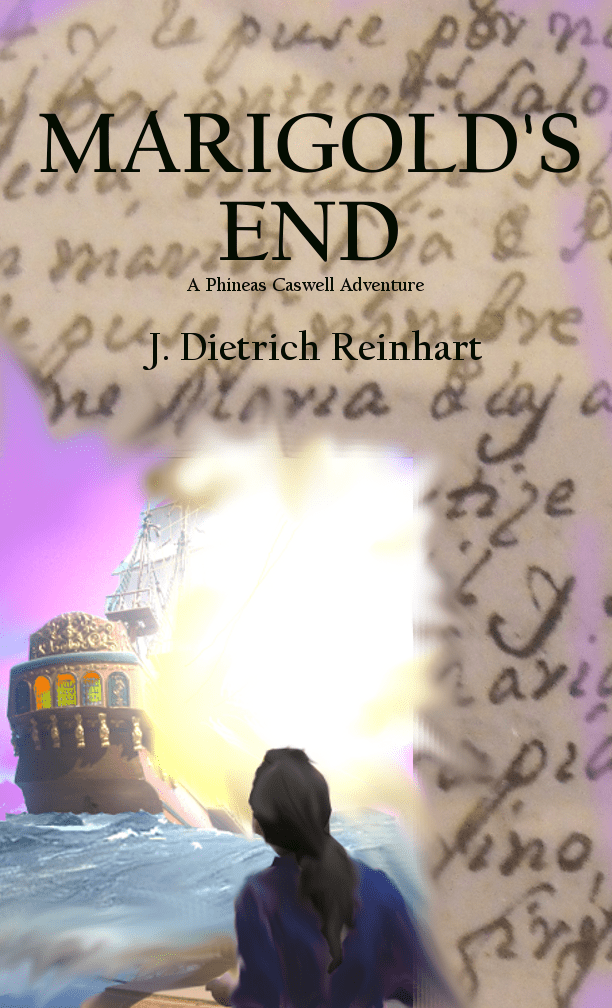
To that end, my book, PHINEAS CASWELL, is now titled MARIGOLD’S END. It ties in with the story, has a dramatic hook, and has the legs to be part of a series, which it will be. Number one in a series.

The energy behind the new title bled over into a new cover, which I think is exciting and intriguing at the same time. Now we’re getting somewhere!

Eliminating Was

007

Writing for the now, writing with action and verve, can be a challenge. Lets’s try that again: it can be tough to write good action sentences. Passive sentences certainly have their place in expressive, contemplative and descriptive passages. But they can spell death for an action scene.

Lothar was waiting behind the door, anxiously clutching the hatchet. VS Lothar anxiously clutched the hatchet on the other side of the door.

The second sentence implies action and shifts the focus to Lothar, where the first sentence describes what was on the other side of the door.

I issued this challenge to myself in the reworking of Phineas : eliminate the word “was”.

To accomplish it, I used Word’s Find feature to examine each instance of the word and come up with a better alternative. The word absolutely fits in some circumstances, such as in dialog. But, in most cases, a better word choice, and perhaps a more expressive sentence structure, can usually be found. I mean, you can usually find a better word choice!

Was is a pervasive word that can drop an anchor on your action passage.

The Exoplanet Mystery Continues

Image: NASA.gov
Image: NASA.gov

The readership puzzle surrounding exoplanets, those planets that orbit stars other than our own, continues to deepen.

My articles with the word “exoplanet” in their title have an immediate and extensive readership compared to those that do not, even though the article search terms are the same.

Readership numbers at Science Ray, my science article publisher, leap through the roof when an exoplanet piece publishes: my daily readership shot from 150 to 2,200 with this latest piece. The numbers are slowly declining as the piece ages, but the boost in the daily average remains mystifying.

I feel like Butch Cassidy: Who are these guys?