Cliffhanger Marketing

Image: Wikipedia
Image: Wikipedia

 When we left our heroes, Norman, Jake, and Wanda dangled over the boiling lava pit, suspended in the air by a single strand of dental floss.

 “I believe it’s beginning to stretch…” Jake gasped.

The cliffhanger, the white-knuckler squeaker of a nasty dilemma that makes you just want to, makes you just have to, makes you just DIE to start the next chapter and see what happens, is an old, old way to sell stories.

Scheherazade used them to keep herself alive in the One Thousand and One Nights, remember? The king was going to lop off her head when she reached the end of her story, so she spun out cliffhangers, night after night, until he finally said “dude, like, cut it out!” That may be a loose translation.

The upside of cliffhangers is that you bring the audience back for the next chapter. It’s rather a component of gorilla marketing, wherein you don’t do anything, and let the story do all the work.

The downside is that your story becomes lurchy, if that’s a word, and rather roller coastery, if that’s a word. Your sensitive love story about a girl and her pet dragon must necessarily take a turn for the violent, or for extreme emotions: I HATE you, Nogard bellowed. The end.

Another downside is that cliffhangers become rather tedious. For goodness sake, can’t he AVOID the traps once in a while? The old Batman TV show had just 22 minutes to get out of a cliffhanger, tell some story, and get into a new one, making the Caped Crusader seem, I don’t know, rather cartoonish?

So, it is with a blend of cliffhangery, if that’s a word, and gorilla marketing, that you now find Chapter Two of MARIGOLD’S END here on this very site.

Taa Daa!

As you’ll recall from Chapter One, our troubled twelve-year-old, Phineas Caswell, points the loaded pistol,  trigger-finger itchery (if that’s a word), squarely at the running-away back of Alfred Townsend, the unarmed bully that has made his life a living hell. Will he pull the trigger and end his woes? Will He? WILL HE???

Well, now you can find out. The second chapter, cleverly titled Chapter Two, now has it’s own page. Oh, and you’ll be surprised at the turn of events.         I hope.

Now you can read the chapters, build up steam, get rolling in MARIGOLD’S END, and wait breathlessly for Chapter Three. Oops – I gave away the title!

Before you get all wormy-squirmy and palm-sweaty like you do in the seat across the car dealer sales manager (How am I going to get you into that car today, friend?), I must remind   you: this is gorilla marketing. Don’t buy the book – you can’t!

But, let me know what you think, would you? Liked it? Hated it? Mondo disregardo? Your feedback, my independent writer friend, is most needed.

Now, I’m not desperate – I know that’s what you’re thinking.  But, I’m not, I’m not, I’m not. My darling editor is moooviiiing soooo slooooowly, think of this as Plan B.

Your input, spread out over the number of weeks over which I plan to release a chapter…let’s see, here, 18 chapters, take away the 2 I’ve already released…let’s see, carry the 1…should coincide with her completion of her editorial chore.

Badda boom, badda bing, and all I have to do is NOTHING! Now THAT, my reader friend, is gorilla marketing!


Designing a Book 


CarlsHouse

At first you think, whoa, I am, like, so going to write this book that it’s just going to be the best darned thing anybody has every gosh darned read. Then you sit down at the word processor…

It was a dark and stormy night…backspace, backspace, backspace

You may wonder why I’m dead… backspace, backspace, backspace

You’re not the boss of me, Timmy snarled… backspace, backspace, double backspace, control-X

All right, so, that knock at the front door is clearly not your muse, come to enlighten you…

My book, DROPPINGTON PLACE, has gone through iteration after iteration, the story orbiting around plot point after plot point, through about 17 “hot-dang, this’ll be good” rewrites, and finally sat down and breathed out.

That’s when Byron, the protagonist, stepped in. It turns out he really did have a story to tell – something serious he wanted to say. His story is actually pretty good – a little calm compared to previous editions of his book, but pretty good.

In the original story, Byron finds himself transported to a world of paper, run by a magical being called a homunculus. However will he get back? Assisted by two human friends and a couple of paper people, he eventually gets the homunculus to send him home. Yawnzers, kids. It’s a cool idea, but, like the paper world he visits, seriously flat.

Byron recently announced that he was not happy in the 3D world. His father has left. His mother has “episodes” that pull her emotionally far away, and he misses his best friend, left behind when they moved to a new town. He finds his escape from his woes by building paper houses.

The paper world into which he is thrust holds much more mystery for him, and might even be a place in which he can find respite. We spend most of the story wondering, with him, if the place is real or a dream. The homunculus is a paper copy of a 15th century playwright, and stands in as sort of a father figure for Byron.

We still have all the interesting paper stuff going on, and there’s a bad guy, but that’s no longer what drives the story.

The motor behind the story is Byron’s emotional arc, as he learns to cope with the many difficult issues he must face.

Fine, fine, well and good. Jeepers, mister, you’re a GENIUS, but having a character arc don’t do crackers for the structure of the book.

To remedy that ill, I broke the cracking-good synopsis for DROPPINGTON PLACE into chapters, to wit:

 “…

Chapter 2

At first the fascinating paper world is appealing, as it provides an escape from the woes of the real world. But, after seeing a 3D human like himself turned into a 2D paper person, he realizes he is in danger.


Chapter 3


Searching for a way out, he meets Hailey, a strikingly bright and hopeful 12 year old, who hopes to assist the tiny man requesting help. She uses her knowledge of magic, gained through reading a series of young-adult novels, to explain and understand the paper world. Together they witness Hobbs turn a 3D human into a 2D “flatso” as Byron calls them. They realize that Hobbs is the way out, and decide to visit his castle, Hobbs Manor…”


Now Byron can say all the stuff that’s important, but the rhythm of the book is a flow that can be managed and developed. Each character can say their important stuff, but this outline tells them when to say it.


There is a danger, my writer friend, of getting too detailed in the outline – I know some writers who fall into this sinister little trap. They write and write, not on the book, but in the outline, and solve all of their puzzles so thoroughly that they now see no need to write the book!


So, sketchy and loose, detailed but easy-peasy, that’s the road for Byron!

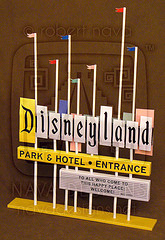
Writing at Disneyland

Image: Disneyexperience.com

There’s something sort of crazy about being, well, sort of crazy. At the top of the list is that you don’t have to explain anything – well, I’m just sort of crazy like that.   You get lots of clever adjectives, like quirky, and different. And, because you’re just sort of crazy like that, you know, quirky and different, you find yourself with lots of free time on your hands. Let’s not invite her – you, know, she’s quirky and different.

This big and mighty world tries really hard to convince you that being busy is doing something. You can be busy all day long at Disneyland, but, what have you accomplished beyond exhausting yourself and dropping two hundred bucks to a guy in a mouse costume? Nothing, Jack. For all that busyness, you accomplished nothing.

So it is with we quirky, different writers, dontcha think? This endeavor right here, this very one you are reading, which hopefully brings a smile to your erstwhile lips and perhaps gives you something over which to mull when you are not busy being busy, may very well be busyness for the sake of busyness.

It occurred to me while thinking about marketing…I mean, promoting…my book, my mind spinning feverishly like a rabid squirrel in a hamster wheel, that there is nothing to do about marketing…I mean, promoting…my book until my adorable editor is done with it. For the record, she did say she thought this was the best so far, but had scarcely started chapter two. Sigh.

Without a product, what is there to promote?…coming soon from John Reinhart, the author who is, well, uh, is kinda waiting in limbo while his editor wraps up his glorious…wait, where ya going?

BUT, there is a sequel to MARIGOLD’S END, tentatively titled PELICAN’S WAY… there’s sort of a theme here, see, where the Marigold is a ship in the first novel that gets blown up…oh, poop, I spoiled the ending…double poop, because NOW I spoiled the ending by telling you that Phineas blows it up at the end of the book…oh, triple poop! So, see, Pelican is a ship in the next book that gets…well, you’ll have to read that one.

Anyway, the rabid squirrel brains rattled out a good synopsis of that book on Tuesday. And I must say, it’s a ripping good synopsis, as synopses go. That was Tuesday.

On Wednesday, the quirky, different sort of crazy writer that I am, I sort of cracked out a terrific synopsis for my other series of books, called DROPPINGTON PLACE. For a preview of Droppington, scroll to the bottom of this page and you’ll see that I have a blog for that, too. Oh,  I’ve thought of everything.

So, while my lovely editor does everything other than edit my book, my NEW plan is to work on DROPPINGTON PLACE. And thus my hands will be busy.

But, is busyness productivity? If the words crackle and dance from your fingertips, but never get published, is that accomplishing anything?

Maybe that’s why my crazy, quirky, different friends are so fond of Disneyland.

Change Your Marketing Mind

image

The world changed while we were sleeping. It used to be kind of a pain in the bum to hand-write stuff. I mean, you have to get the paper, to get the pens, and most often you had to get the erasable pen because none of us is that good of a writer. But then came typewriters and hey that was pretty cool.

Word processors, those phantoms of the future, made it so easy to create good literature. And then, along came speech – to – text.

I was going to write this post and complain about how difficult it was to use the tiny keyboard on my cell phone. But then I discovered this speech-to-text dealio. Now I am speaking slowly, and clearly, but allowing my inner whatever that is to flow through my lips rather than through my fingers. queen.

The word queen is what my speech – to – text engine things is the word whee, so there is a lot of work to do yet. But, imagine the possibilities for those of us who are too lazy to type the little finger things on our cell phones.

Speech – to – text is supposed to be for those people who have trouble typing. Well, if you are like me, typing is too much trouble. So, I suppose speech – to – text is for you and me. Cool.

How does this relate to marketing? Think about it: you can just open your mouth and create great stuff! Or, if you are like me, you can open your mouth see mediocre stuff, and then go back and type it in correctly.

While we slept, the world changed. This new world is much more friendly to everyone. Even those of us too lazy to type out our marketing messages. Cool!

Elevator-Speech Dustcover Marketing

Marigolds End Fin

Don’t you hate those people who sum up their lives in, like, fifteen seconds? What do I do? Well, after I graduated with my MBA from Dogsnorton University, I became the sales manager for Incredible Products, the premier manufacturer of sodium-hydroxide based whisk-broom filaments with offices here and in seventeen other countries. Perhaps you should look into purchasing sodium-hyrdoxide whisk-broom fliaments. Your first thought: don’t these elevator doors ever open?

On the one hand, it’s nice to know what that person is all about. On the other, an elevator pitch invariably leaves you standing there saying “uh, well, huh, how about that?”

Sadly, this must become you. Wait, don’t go! …well, go if you must. But hurry back.

The fellow making his elevator speech to you is showing you a sign, paving your road, mentoring you, yes, you. Instead of muttering “you’re ticking me off, Phil,” you should take a mental note. Use a pencil if you have to.

This person is showing you how to market your book. He’s not exactly granting you permission to be annoying and mono-focused, but he is giving you a great example of how to sell. His elevator speech is guiding you in creating your dustcover speech.

When you buy a book, you don’t just read the front cover. You flip it over and read the paragraph on the back of the dustcover to see if the book has more than just a cool picture to recommend it. That guy’s elevator speech is his dustcover paragraph.

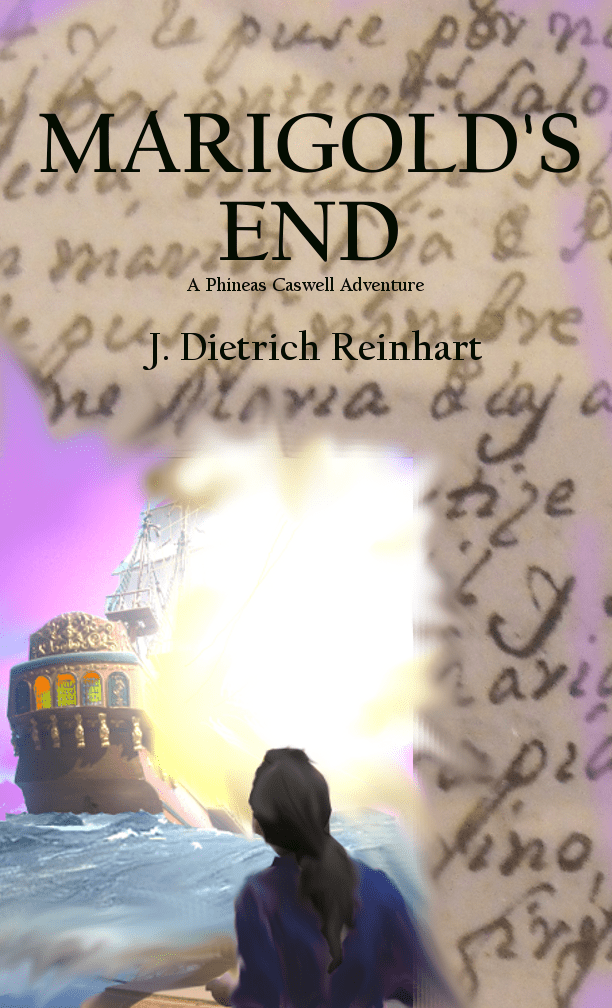
Here are two dustcover paragraphs on my book, MARIGOLD’S END:

The deep blue sea has haunted and hunted twelve-year-old bookbinder’s apprentice Phineas Caswell ever since it took away his best friend and his father. Now, shanghaied aboard his uncle’s ship, the Kathryn B along with his new-found friends Louise and Taylor, he must face pirates, storms, and the secret of nations as he learns the meaning of trust and the value of responsibility.

 …and…

Everything happens to twelve-year-old bookbinder’s apprentice Phineas Caswell: his father and best friend are taken by the sea, he’s beset by bullies, and he’s dragged off to sea by his uncle. But, after learning the ways of sailors, after battling ruthless pirates, facing storms, and even determining the fate of nations, he realizes that life is not what happens to you, but what you make it.

So. Which book would you buy? – I’m sorry, “neither” is not a valid option. I’m still trying to decide which of these best describes not just the story, but the style of the book. Like the elevator speech, how you say what you say says what you need to say, too. Well, I say!

The second book sounds like more fun, but the first book might teach you more. I haven’t figured out which one I like yet – your input would be appreciated before you leave the elevator.

So, go out there and practice your dustcover speech. Who knows? Someday you might be on an elevator, and someone might ask what you do. You turn to them and say “Everything happens to twelve-year-old bookbinder’s apprentice Phineas…”

Don’t these doors ever open?

De-Energizing Anti-Inertia

Photo: HowWeDrive.com

Time rolls like a jelly-roll, right down the hill with the biological waste-matter, for we all know poop rolls down hill. That’s why your boss can give you dreadful assignments with such cheerful abandon, because poop lands on the desks of bosses with the express goal of rolling down the hill to your desk. If you are a boss, good on ya, mate, because you can roll your poop to the next level below. But I digress.

Time and energy are inextricably intertwined. Don’t think so? Why don’t you drive at 85 mph down the interstate when you’ve got six hours to get there…unless you are one of THOSE, who can’t drive 55… was that Sammy Hagar? Wasn’t he horrible? Or was that Hagar the Horrible, who drove too fast in the… but I digress.

What stands between you and your finished work – and by finished I don’t mean lookee there, Slim, I rot me a boook! – I mean a finished and produced piece that, if not published, is well down that road. In fact, let’s take it a half-mile farther down the road and say your work is not finished until it is published, and easily accessible by the world at large.

Wow. That’s a big goal. You took the time and heart and effort to write your book, didn’t you? Good on ya, mate! That’s your heart and your art, and, even though we tell our friends and admiring toadies that it was tons of work, you know in your artistic heart that it was fun. Go ahead, admit it. We probably won’t tell.

There was so much inertia to get the book done – day after tedious day (wink) of writing to tell the story, get those characters’ voices out there- be free, my creepy inner friends – with a single goal in mind: The End.

Publishing it. We-heh-heh-heh-ell, now, that’s just a whole new kettle of friskies, in’it? How do you do it? My proofreader moved on before he finished my book – well worth the nothing I was paying him, I say. An editor? An EDITOR? Those cost around a thousand bucks, my ramen-eating friend. And then, say we finally get the thing proofed and plop down half of the house payment and get it edited: crickets.

I came of age in the business world – you probably did, too. We know how to get things done, you and I. Mimeograph this, would you? Did you order more ribbons for the Selectric?   Can you smell the ditto machine? Publishing… oy, now, that’s going to use our business acumen, and other parts of the egg.

All the inertia is lost. A wide set of skid marks veer off the shoulder and into the bushes on the other side of the ditch. Maybe it’s off the road, or maybe it’s running down some hidden lane only the driver knows. Whichever way it’s going, it aint towards success.

The hardest part of this book-writing exercise is the now, right here. The thing is done, but there is nowhere to go with it. I’ll let you know if I get out of the bushes.

Stick a Fork in Me

Marigolds-End-Done

Done like a ton of finished, like a taco casserole in a thousand degree oven I am done, done as the day is long, done. Finito. Wrapped it up. Did the deal, finished across the line with a big ol’ smile across my face. DONE!

72,584 words of pathos, humor, and history all wrapped up in a nice little package featuring my friend Phineas, who gives up, gets angry, blows his top, cries, and finds his father, all the while fighting a running battle with the sea. Phin, my boy, carped at by the ship’s sailing master, driven to near distraction by the French king’s granddaughter, and called every harsh, rude, hurtful name in the book, tries to find his way, figure out how he got thrown into the seagoing gulag that is the Kathryn B.

Not a spoiler alert, not here – you’ll have to read for yourself how this one turns out.

In fact, my next step is to find a reader. Someone who can be honest with me, but someone who knows a thing or two or three about the Young Adult Fiction business, what they’re looking for, what will float, what will sink like a stinking stone.

Really, my next stop is on the publishing wagon. Get this monster read by someone with brains, rework it to their thoughts, and then Wordsmash it or Yahoo it or Amazon it or something.

Really, the next step, which starts tomorrow, is to think about marketing. Building the old platformaroony that will carry this book into the bazillion dollar sales range.

You, my friend, need not worry. I will not try to sell you a book. You are my only reader, and I thank you for sticking with me. Stay with me, sail with me over the horizon of the publishing adventure. I promise to tell you everything. The rewards could be great.

For now, the goal is to simply enjoy 72,584 words of doneness. Finitoness. Ah, sweet victory, thy name is Phineas.


The End of the World

It could all be whipped away from us in the very blink of an eye, this trusty old world of ours. I might not even be able to finish this post because the dumb old world ending thing might happen fir… st. If you’re a fan of Dr. Who, it almost happens every week.

On a totally different subject, my wife and I were talking about absolute cold… well, I was babbled about it and she was very nice… absolute cold. So cold that all of the heat is drawn out of the molecules, down to the quarks and their cousins falling to infinitesimally small particles of nothing, but not falling because there is no energy. No energy, no heat, but absolute cold. Maybe that’s the end of the world.

Or, maybe it happened today, when my daughter told me that maybe I should reconsider my book – you have a good idea, there, but maybe you should write it this way. Excuse me? Excuse me? Excuuuuuuuuse me? You’re my kid. You’re supposed to think it’s better than Gone with the Wind, for crying out loud. Maybe it would be better if…?

It’s not the end of the world, but, you’re a writer, you know how it feels.

This afternoon was supposed to be a nice editing session, powering through the last quarter of the book, reworking working sentences into elegant, beautiful descriptions of the human condition.

He pulled the trigger. The pistol exploded in fire and smoke. The pirate swore and ran for the ladder. Lah dee dah dee dah.

Maybe she’s right. Maybe I should sit down and write a book like J.K. Rowling, or Stephen King.   Yes, perhaps I’ll try that. Maybe I’ll just write version seven of this stupid book off as a whim, one that’s lasted a good six years, and do something else. I hear that wallpaper’s easy to hang. Taco Bell’s hiring.

It’s not the end of the world. But some simple conversations can cool your heart until the quarks cease their tiny orbits.

Now, I’m not complaining. I am sharing this with you, dear writer, because the day may come when a loved one delivers to you the blow that ends your world, your entire universe.

But you know that you’re good – you just have to hold onto that, because you ARE good, dear writer. And tomorrow the sun will come up and the absolute zero in your heart will thaw, and your muons will start their crazy dance, and life will go on.

And you’ll think about what you’ve been told, and you’ll put it into the salad bar of your mind, right next to the windmills, and continue your work.

See? It wasn’t the end of the world.

Creepy Little Voices

You know the line of jokes: the little voices made me do it, I only do what the little voices tell me, how do I know you are not just another little voice, etc.

So, rattle me this, Bidman: you’re a writer, right? You write dialog, right? In that dialog, your characters say stuff that sometimes surprises even you, right? So, like, where do those words come from?

Is not the character you’ve created exactly like a little voice in your head? Consider:

Bob:     You don’t even know my last name…

 Julio:   But I could, man! I’m telling you, we could be famous.

 Bob:     Julio, I don’t want the kind of fame you’re suggesting.

 Julio:   Aw, come on, Bob. At least think about it.

I just shot that little gem right there out of my head, unconsidered, unrehearsed, and un-edited. I know, I know, hold the applause.

So, like, where did it come from? The names popped up as I typed them, and the dialog followed along. In the first line I thought Bob might be talking to a girl, and I almost typed   Julia, but I didn’t like Bob’s tone. So Julio is proposing something that will make them famous, but Bob doesn’t think it’s a good idea. Boy, how much story can you get out of just four lines?

In the rule book for regular folks, How to Be a Regular Person, by Ima Sandwich, it says that the little voices in your head are bad. They are destructive, and not real.

But, if you write down what the little voices say, you could be famous. And not for, like, blowing up dams and stuff, but good things, like writing fine, fine art.

Alas, my little voices aren’t good enough for fine art. They come as the simple regurgitation of all the hundreds of thousands of lines of dialog and conversation I’ve read and heard over the last half-century.

But isn’t that what writing really is? Don’t you mish-mosh ideas together and come up with characters for your novel? Doesn’t Cyrus say something that sounds like something you’ve heard before? Or Ethel? Rodney? Ralf? Aren’t they kind of barfing up old conversations in new, and sometimes surprising ways?

An actor memorizes his words, but the feelings behind them come from deep inside him. He applies his five or so decades of experience to the character he portrays, even though he’s never had to face the character’s exact circumstances.

Dollars to donuts says that you are doing the same thing with your mightier-than-the-sword word processor. Especially if you write horror, and your characters say the creepy stuff that the media tells is what the little voices say.

The answer is probably that, because you don’t act on the little voices, you’re not crackers.

But, tell me you haven’t awakened in the wee small hours with a perfect line in your head: Jackson says “well, it looks like rain to me.”

Thank you, little voices.

Alert: Monster in the Cupboard (not Closet)

If you write a lot, but don’t get feedback, yours, my friend, is a lonely game. You toil away, fitting together the pieces of your written puzzle like so much cheese at the mousetrap factory, when, one day, the monster grabs you.

I am a miserable novelist. I just realized it. Not misery like in hey lady, that was my ANKLE thank you very much, but in misery as in whoa, dude, do you, like, know any words? How many ways can you say “said” without sounding moronic, he intoned.   Whimpered, whispered, hissed, murmured, muttered, uttered, grunted, yelled, roared, bellowed. Well, that’s it for me.

And that sentence structure, what’s up with that? He opened the door and looked inside as the tree fell through the neighbor’s roof. He drove the car and whistled a happy tune as the rain pattered joyfully through the open sunroof. He wrote the post and congratulated himself on at least writing something as he bored his reader (bless you, whoever you are) to tears. Subject verb the noun clause and verb a noun clause as noun verb preposition noun clause. Booooooooooooooring.

Maybe it’s because, as a technical writer, my is writing is limited to “attach the motor mount to the casting with (2) socket head cap screws.” It isn’t romance, but it pays the bills. While it’s easy to write “carefully place the hinged device against the casting and thread the screws, one-by-one, into the small holes”, my editor would hand it back to me faster than a greased bowling ball on Crisco Boulevard.

In truth, there’s something else going on.

You’re a writer – I ask you: who is your worst critic?  Go ahead and think, we’ll wait… do you need to make a phone call?

Of course it’s YOU, you ninny!

Except not really you, but the monster in the cupboard. I was going to say monster in the closet, but that now leads to coming out of the closet, which has a whole different meaning than what I was shooting for, and oh, now everything’s all tangled up. One moment, please…

So, the monster in the cupboard is your own self-doubt, self-fear and self-loathing (if you’re in Las Vegas), trying to sell you a bill of goods. I know it’s just a bill of goods because my daughter told me today that she likes my book better than Hunger Games. She might be bucking for extra allowance, but I’ll take what I can get!

The monster lives in the cupboard of your mind, next to the windmills, and sees the absolute worst in everything that you do. And it loves, Loves, LOVES to point it out to you.

Part of the monster is good. I mean, it’s the only one who makes you go back and polish that sentence once more – you know it needed it. It’s the only one who makes you question whether this book really needs this scene.

But the monster is also baaaaad, baaaad, because it can convince you that you are a miserable writer. You know it isn’t true, but the monster seems so authentic, so… so… so right.

You know that you are the monster – your parents said you were a little one when you were a kid – which means you can stop being the monster.

The next time you flop into a heap in front of your word processor, crying because you just aren’t good enough to write this book, and you really should not have quit your day job, and how could you have EVER thought that you could do this…well, you can just stop it with the Mr. Nastypants routine.

Nobody’s buying it, and you’re just being a whiney crybaby because you listened to the monster in the cupboard.

Shut the cupboard and get back to work.